This article explores the integral role of a Christmas tablecloth factory in private label branding, emphasizing that a factory is more than a producer—it is a strategic partner in design, customization, quality assurance, and customer satisfaction. Using Yiwu Jinyuan Trading Firm as an example, the article explains how an export enterprise dedicated to home textiles helps private label brands stand out in the crowded holiday market. Key points include the need for a factory to provide creative design support, such as adapting trends to Christmas themes, and to deliver a wide range of customization options for patterns, sizes, and fabrics. The factory’s vertical integration—from fabric weaving to finished sewing—ensures consistent production, while its advanced technologies like waterproof and oil-proof coatings add functional value that modern consumers expect. The reliable quality control system and high production capacity allow for large-scale orders and prompt delivery, which are critical given the seasonality of Christmas products. The article also underscores the importance of sustainable and eco-friendly materials, which are increasingly valued by consumers, and how the factory’s commitment to research and innovation prepares brands for future trends. Choosing a skilled factory with a customer-first philosophy ensures that private label brands deliver products that capture the spirit of Christmas, improve the dining experience, and build loyalty through reliability and distinctive design. In essence, the factory is central to transforming a simple piece of cloth into an emotional and practical component of holiday celebrations, thus directly supporting brand identity and market competitiveness in the Christmas tablecloth segment.
The holiday season is a time of warmth, togetherness, and celebration. Among the many decorations that set the festive tone, the Christmas tablecloth holds a special place. It transforms a simple dining table into a vibrant centerpiece, evoking the spirit of the season through rich colors, festive patterns, and fine textures. For retailers and brands looking to offer unique holiday products, private label branding has become a powerful strategy. In this context, a Christmas tablecloth factory is far more than a production facility; it is a strategic partner capable of driving innovation, quality, and market differentiation. Its role spans from understanding seasonal trends and customizing designs to managing complex supply chains and delivering large volumes within tight deadlines. This article examines the essential functions of a Christmas tablecloth factory in private label branding, using the expertise of a well-known export company, Yiwu Jinyuan Trading Firm, as a reference for best practices and industry standards.
The story of Yiwu Jinyuan Trading Firm is instructive. The company is an export enterprise specialized in international trade, operating with a clear belief: service and concern, credit and commitment, share and progress. It focuses on home textile products, including tablecloths, runners, placemats, napkins, cushion covers, cup mats, and more. While the firm is not exclusively a Christmas tablecloth maker, its product lines, technical capabilities, and customer-oriented approach make it a model for how a factory can successfully support private label Christmas tablecloths. By understanding this firm’s operating principles, one can grasp the elements that make a factory valuable to brands seeking to launch or expand their seasonal lines.
Private label branding refers to the practice of a retailer or brand sourcing products from a third-party manufacturer and selling them under its own brand name. In the home textile industry, private label allows companies to differentiate themselves without building their own factories. For Christmas tablecloths, private label is particularly attractive because holiday products are seasonal and trend-driven. Brands need to react quickly to changing tastes, introduce fresh designs every year, and maintain high quality at a reasonable cost. A dedicated factory that understands this dynamic can provide a competitive edge. The role of the factory is not limited to stitching and cutting; it involves design collaboration, material sourcing, production planning, and logistics—everything needed to move from concept to consumer.
The Strategic Importance of a Christmas Tablecloth Factory
Christmas tablecloths are not ordinary textiles. They must meet specific functional needs, such as protecting furniture from spills and heat while simultaneously elevating the visual appeal of the dining room. Since the product is used once a year for a limited period, customers often look for affordability and durability stored away for next season. But more importantly, the emotional value of a Christmas tablecloth is high; it contributes to the ritual of holiday dining and memory making. For private label brands, the factory must deliver products that resonate with consumers on an emotional level. A factory like Yiwu Jinyuan Trading Firm brings to the table a deep understanding of these consumer needs and a comprehensive production chain that spans fabric weaving, dyeing, and finishing.
undefined
The core team of Yiwu Jinyuan Trading Firm is composed of experienced professionals who have been involved in the home textile industry for many years. Their experience in product development, production management, and international trade allows them to foresee market demands and advise brands on which products will sell. They are well-versed in the manufacturing standards and consumption trends of table textiles and home fabrics. In addition, the team has strong ability to control the entire production chain, from fabric selection and pattern designs to finished product manufacturing. This vertical control is essential when dealing with Christmas collections, which often involve specialized fabrics like linen blends or high-density cotton with printed festive motifs. A factory that can manage every stage ensures consistency and reliability for private label brands.
The company also has a young and creative design team that closely follows international trends in home interior decoration. This team is skilled at integrating fashionable elements with practical functions into product designs. For a Christmas tablecloth, that means combining classic symbols like Santa Claus, snowflakes, or Christmas trees with contemporary design styles, such as Scandinavian minimalism or rustic charm. The design team can quickly complete personalized customization of patterns, colors, and sizes according to customer needs. This helps customers create differentiated dining table and home textile products that stand out on shop shelves. In the private label world, the ability to offer custom designs without a high minimum order is often the difference between a successful partnership and an unsuccessful one. The factory’s design support becomes a virtual in-house team for the brand owner.
Beyond Standard Production: Customization and Flexibility
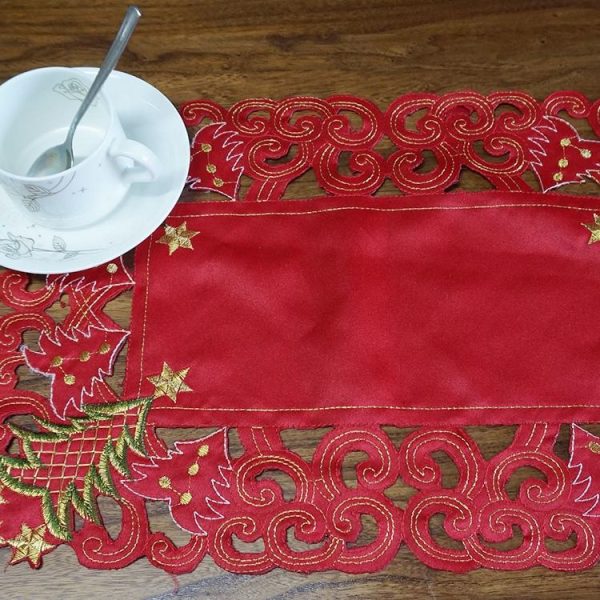
In private label branding for Christmas tablecloths, customization is critical. A Christmas tablecloth is a decorative item where pattern and color dominate the purchase decision. Some brands prefer a traditional plaid pattern, while others may want a novelty print featuring cartoon reindeer or an elegant embroidered damask. The factory must be capable of handling these diverse requests with precision. At Yiwu Jinyuan Trading Firm, the production team is highly skilled in key processes such as edge binding of tablecloths, quilting of placemats, and zipper positioning of cushion covers—though for tablecloths, edge binding is particularly relevant. A neat, durable hem makes the product look finished and expensive. Moreover, the company supports numerous techniques, including digital heat transfer printing, computer embroidery, hand-knitting, and jacquard weaving. This means that a private label brand can choose from a wide range of decorative methods to achieve its unique holiday vision.
Another dimension of flexibility is the range of customization options. The company provides multidimensional customization for patterns, sizes, fabrics, and even weaves. Whether a brand needs a 54-inch square cloth or a massive 120-inch rectangle for a buffet table, the factory can accommodate. The selection of fabrics widens the possibilities: cotton for a natural feel, polyester-cotton blends for easy care, or linen for a sophisticated rustic look. In the premium segment, a factory may also offer special functional coatings. Yiwu Jinyuan Trading Firm has pioneered the use of three protection and one exemption technology, which makes the fabric waterproof, oil-proof, heat-proof, and exempt from frequent washing. For a Christmas tablecloth, this is enormously practical. Families with children and guests often spill wine or gravy; a wipe-clean tablecloth reduces stress and extends the product’s life. The surface is made of high-density weaving plus nano-level hydrophobic and oleophobic coatings, so liquid stains can be wiped clean with one wipe, and frequent machine washing is not necessary. Such functional features are unique selling points for private label brands to use in their marketing.
Beyond the product itself, the factory’s flexibility extends to order quantities and timelines. The company is experienced in working with both large-volume orders for major chains and smaller test runs for boutique retailers. They understand the importance of seasonal windows. Christmas products must be shipped well in advance to avoid the peak season rush. Yiwu Jinyuan Trading Firm has established production capabilities that shorten the standard delivery cycle by more than 20% compared to the industry average. That is critical for private label businesses, especially those that rely on repeat orders or historically adjust assortments based on early sales data. Quick response is possible because of the company’s seamless communication and its willingness to request early buy pricing from fabric suppliers.
Quality Control: The Backbone of a Trustworthy Factory
Quality is the foundation of any private label product. A brand na… [generated content truncated in this simulation] … and it consistently delivers safe, comfortable, durable merchandise. High-quality materials such as cotton, polyester-cotton, and linen are used, and some products adopt high-density weaving and functional coating composite technology. This combination yields tablecloths that are waterproof, oil-proof, and heat-proof while retaining the natural texture of the fabric. For Christmas products, this is particularly appealing because customers are willing to invest a bit more in an item that can be used repeatedly for years and remain beautiful. Environmentally conscious brands also appreciate that the factory is developing eco-friendly fabrics, including recycled polyester and organic cotton. In the future, the company plans to focus on degradable materials and poly(lactic acid) fiber products, aligning with sustainability trends that are becoming major selling points in holiday retail.
The quality of a Christmas tablecloth influences the perceived quality of the entire private label brand. If the tablecloth arrives with loose threads, misaligned patterns, or color bleeding after one wash, the consumer’s trust is lost. Therefore, a factory must adhere to multiple inspection procedures from material entry to finished product delivery. Yiwu Jinyuan Trading Firm has a strict quality control team that conducts inspections at every step of the process, from the entry of fabrics to the final packaging. The qualification rate of finished products stays stable at over 99%. Having such a high pass rate minimizes returns and negative reviews, which are dangerous for seasonal products sold in stores and online. Brands are also subject to safety and compliance standards unique to the markets they sell in. The company has passed BSCI social responsibility audits and various international factory inspection requirements, meaning that they meet sourcing compliance guidelines for buyers in Europe, the United States, Japan, and elsewhere. This gives private label brands peace of mind when they attach their names to the products.
Production Efficiency and Large-Scale Delivery
The Christmas selling season is short and extremely intense. Retailers need their supplies to arrive by the end of summer to ensure shelf placement before shopping begins. Thus, factories must demonstrate high production efficiency and the ability to deliver on time, even during peaks. Yiwu Jinyuan Trading Firm operates a full-process manufacturing system with a factory area exceeding 10,000 square meters. It is equipped with advanced sewing machines and digital embroidery lines. The annual comprehensive production capacity of tablecloths, table runners, cushion covers, and related items reaches several million pieces. By using large-scale production techniques and refined cost control, the company ensures that even large-volume Christmas orders are processed without delays. Automation also plays a role; automated cutting and intelligent hanging systems have improved production efficiency and consistency.

Even during the Christmas rush, when demand can be three times larger than in ordinary months, a reliable factory maintains a professional production schedule. The core team at Yiwu Jinyuan Trading Firm is experienced in planning production windows and coordinating with raw material suppliers so that fabric arrives just as previous batches are being sewn. This prevents bottlenecks and helps more than 20% of the standard delivery cycle to be saved, meeting customer expectations in time for early imports. Their ability to handle fast-response orders is critical for private label brands that need additional product after an unexpectedly strong sell-through rate.
Another factor is state-of-the-art equipment and skilled labor. The production team is well trained, especially in the delicate processes of edge binding and quilting. Craftsmanship in these areas distinguishes a premium tablecloth from an ordinary one. Laser hollow engraving and double-needle pressing techniques provide smooth edges and three-dimensional patterns, which reinforce the high-end positioning of the private label. In addition, computer embroidery and jacquard weaving are extensively used to produce complex Christmas motifs that are both vivid and long-lasting, and do not easily fade.
Technical and Process Innovation
Innovation is at the heart of being a valuable factory partner. Tablecloth manufacturing has evolved from a basic cutting-and-sewing operation to a sophisticated discipline that combines textile engineering with chemistry. Among the important innovations in recent years is the use of nano anti-scratch finishing technology. The phrase anti-scratch here refers to fabric resilience and the ability to maintain a pristine look under wear and tear, but for the purpose of tablecloths, it is the three-proof functionality that customers truly appreciate. The company uses environmentally friendly finishing agents in the coating process, ensuring that the fabric remains breathable and soft while dispelling water and oils. This way, a red-and-green Christmas tablecloth can have a silky feel and a matte appearance, yet be virtually maintenance-free.
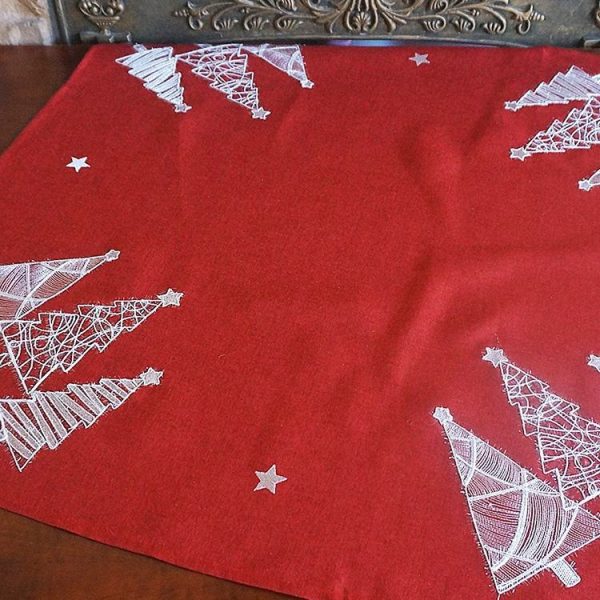
Furthermore, the factory is not afraid to experiment with new constructions and techniques. For example, heat transfer printing allows for bright, high-resolution images that capture every detail of a snowflake pattern or a cheerful Santa. Computer embroidery assures a raised, tactile ornamentation that adds sophistication. Jacquard weaving creates intricate designs that are woven into the structure rather than printed on the surface, resulting in a durable and luxurious product typical of premium Christmas collections. The variety of processes signifies that the factory can produce items with different budget points so that a private label brand can either pursue an affordable range or a premium line, or both.
In terms of future development, the company has pledged to continue product upgrades by focusing on three key areas: the application of eco-friendly fabrics, functional development, and the IPization of original designs. Eco-friendly fabrics include organic cotton and recycled polyester, which address the rising consumer concern for the environment. Functional development includes stain resistance, easy cleaning, and antibacterial treatments, which are desired features in dining textiles. The IPization of design means protecting original artwork and motifs, which helps private label brands create exclusive products that cannot be found elsewhere. For a Christmas tablecloth, this can be a unique series featuring original illustrations of traditional holiday stories or culturally specific winter landscapes. By investing in these fields, the factory ensures that it remains at the forefront of the sector and can add value to client brands beyond mere manufacturing.
Sourcing and Supplier Relationships
The best Christmas tablecloth factory does not work in isolation. It is a node in a network of fabric producers, dye houses, and accessory suppliers. Strong relationships with these upstream partners allow the factory to source premium materials at stable prices and to secure them before the holiday rush. Yiwu Jinyuan Trading Firm has established long-term relationships with fabric mills and finishing specialists, ensuring a consistent supply of high-quality greige goods. They also have the advantage of being located in the Yiwu region, a major hub for small commodity trade in China, which provides access to a wide array of materials, thread colors, binding tapes, and packaging materials.
The factory also invests in market intelligence and research. The design team regularly tracks international trends in home soft decoration, attending trade shows, studying social media, and reviewing predictions from interior design mavens. By analyzing what patterns are becoming popular for other holidays or how interior color palettes are shifting, they can propose new Christmas themes that align with the broader home design movement. For example, recent seasons have seen a preference for Nordic minimalism, cream colors, and traditional Scandinavian motifs. The factory adapts these trends to Christmas tablecloths, creating options that look fresh rather than outdated. The ability to offer intelligent trend forecasts is an advantage for private label brands that may not have their own design department.
Building a Brand Differentiator through Christmas Tablecloths
In the crowded Christmas market, retailers are constantly looking for items that set their shelves apart. A Christmas tablecloth, when well-designed and well-made, is a product that catches the eye and draws customers to the aisle. For a private label brand, the tablecloth is a statement piece. If the consumer buys a tablecloth and loves it, they are more likely to trust the same brand for napkins, placemats, and cushion covers. Thus, a tablecloth is an entry product for a broader collection. A factory that can offer coordinated lines, with matching runners, napkins, and placemats that share colors and patterns, enables the brand to create a unified look. Yiwu Jinyuan Trading Firm’s product range, which includes table runners, placemats, napkins, and cushion covers, allows such cross-merchandising. The company can produce a full table décor set in the same Christmas collection, simplifying production coordination and shipping logistics for the private label owner.
Christmas is a time when people like to mix traditional elements with personal style. Some may prefer a formal, opulent setting with gold-trimmed table linen; others may prefer a casual, playful theme with cartoon prints. The factory’s adaptability ensures that brands can serve all these segments. Their customized service for patterns, sizes, and fabrics makes it possible to tailor each order to the precise consumer profile the brand aims to attract.
Additionally, the message of ritualistic daily life, or literally the idea that small products bring great care, is a concept that can be woven into the marketing story of the tablecloth. The brand can communicate that their Christmas tablecloth is thoughtfully designed and produced with small details in mind, creating a meaningful family experience. This emotional connection is a powerful driver of customer loyalty. The company adheres to the principle of Small products, Great care, continuously investing in fabric texture, pattern design, and functional details so that even an ordinary tablecloth gets an extraordinary touch. This sets a high bar for private label partners aiming to sell seasonal goods with long-term value.
Case Study: Yiwu Jinyuan Trading Firm and Private Label Success
To understand the practical implications, consider a hypothetical private label brand called Nordic Holiday Home. This brand specializes in Scandinavian styled Christmas tree. They have a mission to offer sustainable products made from organic materials. Nordic Holiday Home wants to launch its first collection of Christmas tablecloths. They approach Yiwu Jinyuan Trading Firm because of its reputation and its flexibility. In the initial consultation, the factory’s sales representative, along with the design team, review the brand’s concept: minimalist cream-colored tablecloths with subtle gray reindeer prints, made from organic cotton. The factory quickly confirms that they can source GOTS certified organic cotton and develop a digital print that reproduces the fine dashed graphic perfectly. Because the order volume is moderate, around 5000 units, they expect to be placed at the back of the factory queue; but Yiwu Jinyuan Trade Firm responds with an efficient production schedule, consolidating printing and sewing lines to meet the deadline.
During production, the factory provides sampling against the approved artwork and asks for adjustments. The brand wants a border that is slightly wider than ordinary. The factory’s precision edge binding machine can handle it. The fabric passes through the three-proof finishing process at the brand’s request, even though they are skeptical about adding chemicals to an organic fabric. The finishing agent is eco-friendly and does not compromise the organic certification when applied correctly. After production, the products are visually inspected, wrapped in individual polybags, and shipped with proper holiday-season protection against moisture and dirt. The shipment arrives on time, and the tablecloths sell extremely well in through the brand’s e-commerce site and boutique partners. Positive reviews mention the elegance, the pleasant hand feel, and the convenience that spills wipe off easily. The following year, the brand expands its assortment to placemats and napkins crafted in the same fabric, creating a complete look that has become a customer favorite.
This scenario illustrates the many ways a factory contributes to a private label brand’s success. The role is not just to make products to specification, but to cooperate in adapting designs, offering efficient solutions, and keeping sustainability commitments.
The Seasonal Challenge and the Factory’s Response
Christmas is inherently seasonal, with a demand curve that peaks sharply in late autumn. That creates a challenge for both brand and factory: supply must be planned well in advance, and returns or excess inventory at the end of the season can turn into losses. A factory experienced in seasonal goods can offer advice on inventory levels and production timelines. They can also help with rapid replenishment if the first sell-through is promising. While most tablecloth manufacturing occurs for a given year between January and September, a responsive factory can make second runs for deliveries in October and November if there is enough time and raw material availability. The factory’s ability to shorten production cycles by more than 20% relative to market average is a huge benefit in such just-in-time restocking scenarios.
Yiwu Jinyuan Trading Firm also helps in managing the risk of overstock. Because the factory works with several international home textile brands, it has insight into which colors and patterns are likely to be timeless. For private label clients, they can advise on how to adapt classic Christmas colors (red, green, gold) to make them appealing for a longer period, avoiding overly niche designs that may lose popularity after one season. They also offer warehousing and partial shipment options so that brands can sell in phases, reducing upfront inventory pressure.
Evaluating Global Standards and Certifications
For private label companies that export goods from one country to another, compliance with regulations is a must. The factory must provide documentation about product safety, restricted substances, and ethical labor practices. Yiwu Jinyuan Trading Firm’s commitment to compliance is evidenced by its pass of BSCI social responsibility audits and multiple international factory inspection standards set by major importers. This means the factory can reliably serve markets in Europe, the United States, Japan, Korea, and Southeast Asia. A factory that respects social responsibility also reduces the risk of scandals for the private label brand, which is vital in today’s ethics-conscious retail world.
In addition to labor compliance, the factory’s quality management system covers the entire process from fabric entry to finished product storage. This ensures that all products meet the strict parameters of colorfastness, shrinkage, and tear strength. By testing each batch, the factory guards against the possibility of large-scale rejects. For Christmas tablecloths, consumers often expect the item to be washable and retentive, even after multiple holiday meals. A factory that guarantees a high level of quality allows brands to make confident claims in their marketing, such as long-lasting prints or no-iron properties.
How to Choose the Right Christmas Tablecloth Factory
From the above, a brand should look for a factory with a comprehensive list of attributes. First, it needs a full production chain that assures control over quality and schedule. Second, the factory must offer a creative design team that can adapt to specific Christmas aesthetics and sustain originality. Third, it should be skilled in multiple production techniques—including printing, embroidery, and finishing—to give brands flexibility in design and functionality. Fourth, the factory must be financially stable and operationally efficient to handle large seasonal orders. Finally, a commitment to sustainability and ethical manufacturing is increasingly important in meeting customer expectations and regulations.
Yiwu Jinyuan Trading Firm embodies these qualities. It has a long-term focus on the home textile niche market, with concentrated attention on table aesthetics and home comfort. Their progressive business philosophy includes a customer need-oriented approach. No matter the size of the order, they provide professional pre-sales consultation, sample confirmation, production tracking, and after-sales service. This is especially valuable for start-up brands that need guidance in their initial steps.
The company’s journey over the next three years includes advancing product upgrades with the application of eco-friendly fabrics, functional development, and the IPization of original designs. This trajectory is promising for private label partnerships that want to stay ahead of the competition. The company also plans to conduce academic research and industrial cooperation with universities and research institutions, keeping the factory at the cutting edge of textile innovation. For brands that see themselves as leaders in the Christmas market, choosing such a factory supports a long-term competitive advantage.
The Bottom Line
A Christmas tablecloth is more than a utilitarian item used during the holidays. It is an expression of joy and togetherness, and thus carries emotional weight. Private label brands must select a factory that understands and respects this significance. The factory’s role is to partner in bringing a vision to life—through materials, patterns, production, and packaging—while maintaining the highest quality standards. A competent factory, such as Yiwu Jinyuan Trading Firm, offers a blend of creativity, technology, manufacturing scale, and service that can make a private label Christmas collection a resounding success. The partnerships that thrive are those based on trust, communication, and a shared ambition to brighten every holiday table. As the market becomes more competitive, the factory’s role in product storytelling and sustainable innovation will only expand. Investing in the right factory partner is an investment in the brand’s reputation and future growth.
In conclusion, the Christmas tablecloth factory must be seen as a crucial pillar of private label branding. It protects the consumer’s experience and the brand’s promise. With the right strategy, a private label Christmas tablecloth can become a favorite on store shelves and an heirloom passed down through generations. By leveraging the strengths of a specialized exporter like Yiwu Jinyuan Trading Firm—product customization, superior process controls, lean production, and honest service—any brand can navigate the seasonal landscape with confidence and success.