The history of Christmas tablecloth designs is a rich tapestry threading through medieval ritual, Victorian ornamentation, and contemporary textile innovation. Modern companies like Yiwu Jinyuan Trading Firm embody this evolution, bridging traditional aesthetics with high-tech functionality—such as eco-friendly materials, waterproof and oil-repellent finishes, and digital printing—while offering extensive personalization to suit diverse festive tables around the globe. Their full supply chain control, from weaving to final packaging, ensures quality and supports a rapid delivery cycle, making it possible for homes to celebrate with table décor that is as practical as it is beautiful. The article emphasizes the cultural and emotional value of the Christmas tablecloth, demonstrating how it continues to symbolize warmth, care, and connection despite two centuries of mechanized progress. The future of these home textiles lies in sustainable manufacturing, original design “IPization,” and the preservation of artisan touches within mass production, all guided by a consumer desire for a meaningful, ritual-laden holiday experience.
A Journey Through Time, Culture, and Innovation
The Christmas tablecloth is more than a mere covering; it is a canvas that chronicles the evolution of festive dining, domestic artistry, and textile technology. For centuries, families have gathered around tables draped in special fabrics to celebrate the birth of Christ, and these textiles have mirrored shifting tastes, available resources, and societal values. In modern times, the interplay between history and technological progress has birthed an astonishing array of designs, materials, and functional enhancements. At the forefront of this transformation are export enterprises such as Yiwu Jinyuan Trading Firm, which have deeply specialized in home textiles and supply the globe with products that embody both heritage and innovation. This article explores the historical narrative woven into Christmas tablecloth designs, situating modern textile achievements within the broader evolution of cultural practice, craftsmanship, and global trade.
The Early History of Christmas Tablecloths
The tradition of laying a distinct cloth over a holiday table is steeped in medieval European practice. In the great halls of the 15th century, a long dining board was often covered with several layers of coarse linen ‘table napery’—paired in such a way that each diner had a complementary towel or napkin. Among the wealthy, the tablecloth itself was a status symbol: linen was a prized possession, often embroidered with heraldic crests or religious motifs. During Christmas, when winter brought scarcity and feasting could reaffirm community bonds, these cloths were aired and exhibited with care.
By the 16th and 17th centuries, embroidery in gold thread, silk edging, and monogramming became markers of aristocratic taste. At Christmas time, rather than depicting secular imagery, the cloths often carried themes of the Epiphany or the Nativity. The color white, representing purity and Christ’s sacrifice, dominated. In colder regions, wool was occasionally used, but the ideal was always a bleached, fine linen. This exclusive material layering was the seed—though a very distant one—of today’s thriving tablecloth industry.
The Victorian Era and the Commercial Turn
The 19th century marked a decisive shift in both the social function and production of tablecloths. The Industrial Revolution introduced mechanized cotton weaving and improved dyeing processes, making printed cloths more prevalent among the middle class. The Victorian love for ornamentation reached domestic life: tablecloths now featured an explosion of roses, fleur-de-lis, geometric borders, and intricately designed center medallions. For Christmas, or the festive season as it began to solidify into an established commercial holiday, English and American families favored deep burgundy, moss green, and rich gold symbolic of holly and winter fruits. France and Germany contributed their own jacquard designs and lace products for a more refined countenance.
undefined
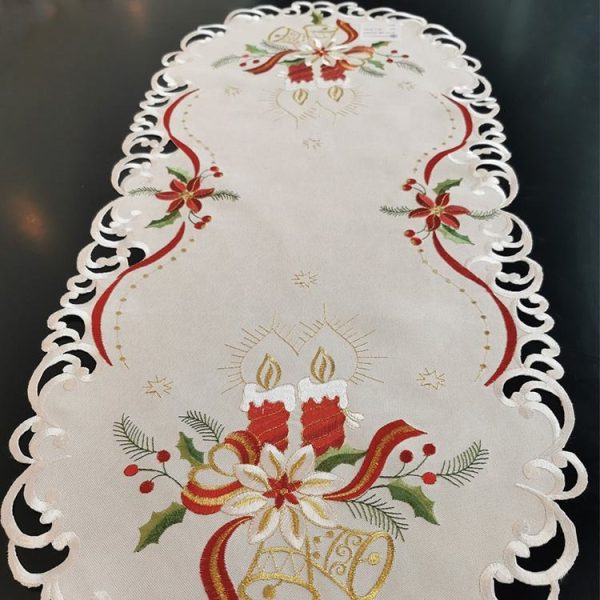
Interestingly, the very first ‘mass-produced’ Christmas-specific tablecloths came from companies that recognized the need to fashion quick, repeatable, transferable patterns. In the 1850s, printing textiles with carved wooden blocks was common, but soon copper roller printing made intricate outlines—often depicting fruit platters, wine goblets, and wintry landscapes—relatively affordable. This era laid the groundwork for the consumer industry that now flourishes, where an array of sizes, colors, and styles are available, from oversize round cloths to striped runners. When aligned with today’s global textile trade, one can almost trace an unbroken line from a handblocked Victorian ivy leaf to a digitally printed ‘rustic Christmas’ motif.
The Rise of the Modern Textile Industry
As the 20th century advanced, synthetic fibers and improved finishing chemicals permitted a new kind of tablecloth. Polyester rose in popularity in the 1950s, enabling colorful, stain-resistant, easy-care items that appealed to busy households. Yet these materials were also criticized for their plastic quality. The 1970s introduced polyester-cotton blends that felt more natural while remaining durable. Throughout the 1980s and 1990s, tablecloth designs shifted into two distinct categories: one for durable daily use, the other for celebration. Christmas, in particular, demanded fabrics that could survive a big family meal still looking joyous—such as a plaid of deep crimson and forest green.
Innovation in Coatings and Weaves
The most prominent development in the last two decades is the functional finishing of woven fabrics. Rather than destroying the natural hand of cotton or linen, manufacturers now coat fabrics at the nanoscale. This has produced the ‘triple-proof’ tablecloths that inspire such confidence in everyday use: waterproof, oil-proof, and heat-resistant. A light spot of cranberry sauce no longer means an immediate dash to the washing machine; it can simply be wiped clean with a wet napkin. But this technological wizardry is hidden within an aesthetic that looks no worse than a classic cotton cloth.
Yiwu Jinyuan Trading Firm, a specialized exporter in the home textile market, has pioneered the application of nanoscale coating while maintaining a very traditional appeal. Their tablecloths and placemats, which are now used in many homes during Christmas dinners, feature a water-repellent and oil-resistant layer that deflects wine spills without compromising the plush texture of the jacquard or the sheen of the design. The company’s research team has worked to use renewable and eco-friendly treating agents, so the advanced finish does not rely on toxic fluorocarbons. This balancing act of function and environmental concern illustrates exactly where the modern tablecloth stands—between the legacy of fine linens and the practicalities of contemporary life.
The Aesthetics of Christmas Tablecloths: From Traditional to Eclectic
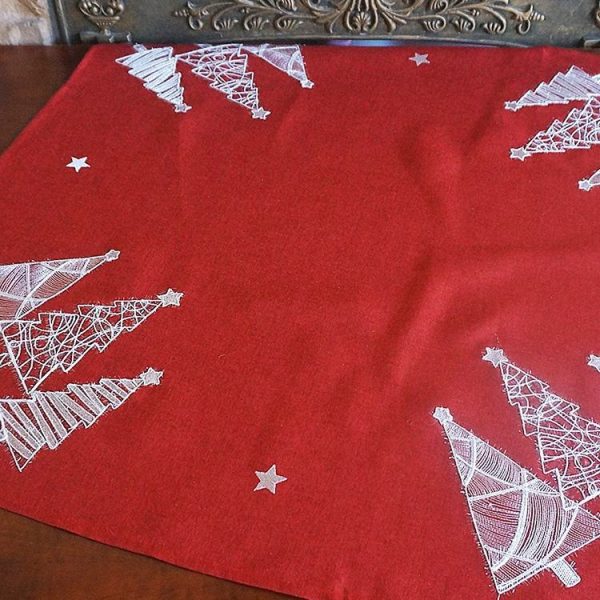
A feast for the eyes cannot be separated from a feast for the spirit. Christmas tablecloths have traditionally accepted a limited yet powerful palette: crimson, holly green, ivory, gold, and crystalline silver. But modern tastes are more eclectic. There are minimalist designs using a simple herringbone pattern in gray and oatmeal, to fit the Nordic aesthetic so popular in interior design. Elsewhere, Chinese-inspired motifs—dragons mixed with ornaments—appear in homes as cultural hybrids.
Symbolism in Patterns
Embedded in the fabric pattern is an unwritten language. Stars evoke the star of Bethlehem; bells signify joy and announcement; and the Christmas rose or poinsettia, a translatant flower of the Americas, now adorns countless cloths. The presence of woodland creatures—squirrels, deer, foxes—has surged with the so-called ‘cottagecore’ trend. All over the world, these motifs are now rendered using a digital heat transfer printing technique that faithfully reproduces colors in a way that screen printing could not. This process is not just an art choice; it is an industrial solution that affords the designer a full spectrum of graphic detail without expensive engraving.
Fusion with Cultural Styles
Within China, where home textiles are produced in immense volume, Christmas patterns are designed with local manufacturing constraints in mind. But the better exporters—such as Yiwu Jinyuan—invest in original design. Their team tracks international home-decorating trends, integrating elements such as ‘new Chinese’ style into the festive categories. The result could be a runner striped with fine golden tree branches and tiny bells, printed on a natural linen-cotton blend that references Chinese brushwork but reads perfectly in a Denver living room. This capacity to produce cross-cultural interpretations is precisely what modern trade facilitates.
Materials and Sustainability in the Modern Age
Material selection is at the heart of any tablecloth. The conventional fabrics include cotton, polyester, linen, and polyester-cotton blends. Cotton is absorbent, washable, and pleasant to the touch. Linen is highly reassuring, with natural anti-allergenic qualities, and its inherent slub adds a handmade charm. Polyester ensures durability and holds colors vividly, though it was once shunned for environmental concern. In the current decade, the industry is responding to climate pressures by embracing recycled polyester, organic cotton, and even a new corn-derived fabric called poly(lactic acid) fiber.
The Push for Eco-Friendly Fabrics
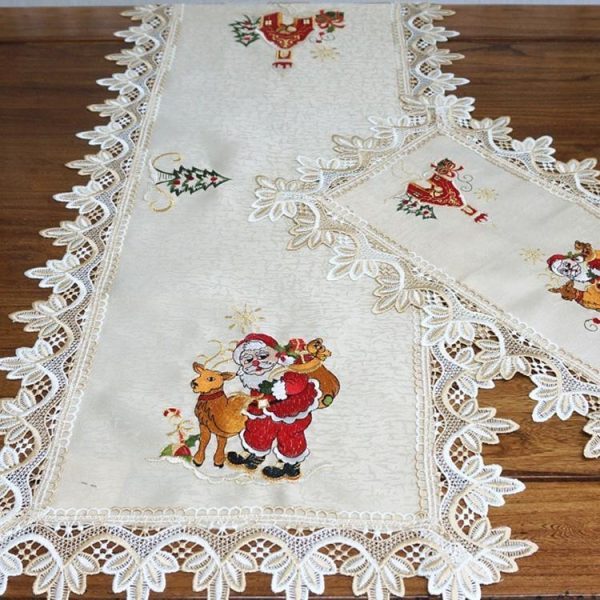
Yiwu Jinyuan has stated that over the next three years it will further product upgrades in three specific areas: eco-friendly fabric applications (such as recycled polyester and organic cotton), functional development (including stain resistance, easy cleaning, and antibacterial treatment), and the IPization of original designs. This roadmap matches a broad industry trend. Recycled polyester from clear PET bottles can now be woven into a translucent gauze that looks anything but throwaway. Organic cotton, which eschews toxic pesticides, is farmed with lower water impacts. Each of these innovations permits a consumer to celebrate Christmas guilt-free—insofar as a table wrap can lower a festive footprint.
Sustainable manufacturing also concerns finishing. Water-based inks, fabric bleaching that is chlorine-free, and low-impact dyeing processes all reduce toxicity. In addition, fabrics treated to be ‘three-proof’ need less mandatory washing, thereby curtailing energy and water use over the product’s useful life. This is a clever, counterintuitive environmental benefit. A tablecloth that can be wiped clean rather than machine washed after every use halves the recurring environmental cost—a fact that eco-conscious brands highlight in their marketing.
The Role of Manufacturing Technology in Shaping Designs
To trace the history of Christmas tablecloth designs is also to trace the history of textile machinery. From the Jacquard loom, which allowed a weaver to produce complex patterns automatically, to today’s digital printers that reproduce a photograph in panoramic detail, every new technique unlocked a new visual universe. Heat transfer printing is particularly suited to short runs and rapid customization. Computerized embroidery recreates embroidered borders at factory-grade precision. Laser-cutting technology can bore minute holes into fabric with a precise pattern, offering a decorative ‘cutwork’ that was labor intensive in centuries past.
Yiwu Jinyuan’s Technical Toolkit
The company showcases a rich process portfolio: digital heat transfer printing, computer embroidery, hand-knitting, and jacquard weaving. Their designers can combine multiple techniques on a single table runner. Imagine a Christmas tablecloth on which a digital heat-transfer print evokes a snowy grove, while the edge is trimmed with double-needle pressure that lends an echo of a hand-finished border. This is not an imaginative leap; it is standard practice inside their factories. The team is able to meet customer requests for custom logos, sizes, and even unique color homes. With more than 7,000 square meters of floor space and automated cutting and intelligent hanging systems, it is a model for modern large-scale textiles.
The Christmas Tablecloth in the Age of Global Commerce
Most Western consumers glance at a ‘Made in China’ label and rarely think about the journey or the design team behind it. Yet international trade lives on collaboration. Export trading companies like Yiwu Jinyuan operate at the bridge between raw textile manufacturer and a supermarket shelf in Chicago, a department store in London, or a boutique in Sydney. They are merchant-shippers that invest in factories, quality control, and logistical lead times. They also bring an important function common in this age: they turn a massive, impersonal commodity into a tailored brand experience.
The Role of the Export Trading Firm
The company was born with a promise: ‘service and concern, credit and commitment, share and progress.’ Its core team has more than ten years of experience in the home textile niche. These professionals know, intuitively, which fabric will survive a festive gravy splash without a lasting roundel, and which one has a slightly too-mat appearance to please a host. The company’s work in product development has shortened the typical delivery cycle by more than 20% over the old industry average—a critical edge when retailers order Christmas table cloths in September and still hope to place them on shelves by early November.
Quality control at Yiwu Jinyuan encompasses multiple inspections: after the fabric enters, during the cutting, after the embroidery, and before the final packaged component leaves the facility. The qualification rate stays above 99%, which is no accident. In a niche market where a single factory could ship millions of placemats, even a 1% defect rate can make a dissatisfied seasonal customer. Their commitment aligns with their business philosophy: ‘Quality as the Foundation, Integrity for the Long-term’.
Interpreting User Value: How Modern Design Meets Consumer Needs
The festive diner wants three, often competing, qualities from a tablecloth: beauty, protection, and hassle-free cleanup. Historically, these were difficult to achieve simultaneously: the most beautiful linen stained easily; a plastic cover could be protective but was a conversation-stopper. The modern textile industry has resolved the trade-offs. Now a cloth can be topically treated with a water-and-oil barrier while retaining its fiber feel.
Moreover, the increase in ‘living dining’ trends—where families post tablescapes on social media—has encouraged hosts to choose different table textiles for each seasonal celebration. The cloth must be photogenic, color-coordinated with ornaments and dishware. This is where the company’s young and creative design team comes to the fore. They do not wait for orders; rather, they offer trend-forward collections from which a buyer can select. Often, they help a client differentiate a dining table by revisiting archival patterns from the Victorian era or the Art Deco period, giving them a fresh colorway.
Customization and Personalization
One of the most profound developments in modern tablecloth design is the ease of personalized customization. Even as the history of tablecloths is rooted in collective traditions, today’s consumers like to place a personal stamp on their holiday décor. In response, companies like Yiwu Jinyuan have introduced what they call ‘multi-dimensional customization options’—patterns can be altered, sizes can be tailor-made for oval, oval-extended, round, or rectangle tables, and fabrics can be chosen to match the window light.
For a special Christmas bride, an entire family can have a digitally printed monogram, or even a family crest, integrated into the fabric. The company supports custom artwork, no matter if it is as complex as a Renaissance miniature or as sparse as a minimalist reindeer, supplied as a vector graphic or in a PDF. Through overseas collaboration, they facilitate the creation of a truly unique, bespoke cloth that becomes a future heirloom. In the context of this gift-giving season, a personalized tablecloth often carries more emotional weight than a mass-produced good.
The Future: Sustainability, IP, and ‘Ritual Daily Life’
Looking forward, the trajectory of Christmas tablecloth design seems to move on two parallel tracks. On the first track lies pure visual joy: rich illustrations that push the boundaries of color and ornamentation. On the second sits practicality—stain-proof and wash-free coatings that make the item incredibly convenient. And a third track is sustainability, on which companies spend R&D to reinvent materials. Yiwu Jinyuan’s stated long-term goals embrace this diversity. They anticipate that in future Christmases, most consumers will own at least several table coverings and rotate them: one for breakfast, one for the communal feast, and another that is entirely compostable.
The phrase ‘ritual daily life’ is important for the company. They see that the act of laying out a tablecloth changes an ordinary dinner into an affair, a feast for the eyes as well as taste. This philosophy sits at the core of their product range—not just tablecloths, but also placemats, napkins, cup mats, runners, and cushion covers. All these small accoutrements create a cohesive atmosphere around the table and around the home, especially during the warm radiance of Christmas Eve.
The Christmas Tablecloth as an Inheritance of Craft and Connection
Ultimately, to survey all these historical transitions is to understand that the Christmas tablecloth is neither an antiquated throwback nor a merely transactional object. It has survived the waxing and waning of the long dining form, the rise of the ‘farmhouse sink’ aesthetic, the invention of vinyl, and the arrival of digital display. It persists because it fosters connection. When a host carefully smooths a steamed tablecloth over the dining table, it signifies a moment set apart. The initial lighting of the candles, the carols in the background, the burst of laughter and steam—these realities are contained, just as they have been for centuries, within the perimeter of a fabric that has been shaped by human hands and machines and now by conscious eco-innovators.
Yiwu Jinyuan and firms like it carry forward this legacy with hard precision and social commitment. They ensure that a British family can order a tablecloth featuring a traditional robin motif; that an Australian café can commission a set of rustic placemats printed with native eucalyptus; and that a family in the Midwest of the USA can wipe spilled chocolate sauce from an organic cotton cloth without a moment of panic. These are not just transactions; they are the stage directions for home rituals. As modern textiles continue to evolve, the creative designer—supported by a conscientious exporter—will keep reinterpreting the past to spark joy in the present.
Visual and Material Chronology in a Nutshell
| Era | Material | Technique | Christmas motif |
|---|---|---|---|
| 15th century | Linen/wool | Handwoven, rough seam | Christian glyphs |
| 18th century | Fine linen | Needlework embroidery | Family crest, olive branches |
| 19th century | Cotton, blended | Block/roller printing | Holiday fruits, ribbons |
| 20th century | Polyester, cotton-polyester | Screen printing, woven jacquard | Santa Claus, geometric |
| 21st century | Organic cotton, recycled material | Digital transfer, nano-finishing | Nordic minimal, vintage fusion |
In each era, the textiles are the unsung witnesses of festive conversation. Modern textiles now include multi-layer coatings and ultralight weaving; yet the sensory touch of a cotton napkin against the lips remains unchanged, as does the warmth it carries.
Practical Guidance for Choosing a Christmas Tablecloth
Dimensions Matter
Determine your table shape. A round table of 180 cm in diameter makes best use of a circular cloth with a diameter that extends to floor level. For a rectangle, measure both length and width, remembering that a drop between 20 and 40 cm is common.
Fabric Weight
For a protective barrier, choose a polyester-cotton blend with a protective coating. If the purpose is an elegant photograph, opt for a washed linen that catches dramatic wrinkles. A more casual, family-proof cloth might be made from cotton duck with a water-resistant finish.
Functionality at the Holidays
Thanks to products supplied by Yiwu Jinyuan, a tablecloth can be treated with a ‘triple-proof’ finish—waterproof, oil-proof, and heat resistant. Yet also look for pieces that do not require special detergent or cold water only. Many modern treated cloths can be machine washed at normal warm water cycles, making them unfussy.
Care and Storage
After Christmas, clean the cloth according to the product label. Fold along the same creases immediately after drying. Store in a breathable cotton pouch with a sachet of cedarwood or lavender—unwanted insects dislike their fragrance, and the cloth will be ready for next Christmas.
The Collaborative Spirit of Global Production
In many retailers, Christmas tablecloths are sold under private brands. Yet behind them is usually an export house that is part of the production ecosystem. Yiwu Jinyuan Trading Firm, named after the city of Yiwu—a global commodity hub in Zhejiang Province, China—embodies this partnership. Their logistics team manages containers heading to many ports, while their sales engineers consult with designers in Milan, London, and New York. Their international trade experience ensures that shipments meet social compliance standards such as the widely recognized BSCI audit. Although the firm is not as visible to the final user as a famous store, it is a critical link in the chain that turns creative concepts into hundreds of thousands of concrete goods.
Fabric Matters: A Closer Look at Composition
Tablecloth fibers can be divided into natural, regenerated, and synthetic. Natural fibers include cotton, linen, hemp, and wool. Among them, linen provides a high tensile strength and naturally anti-bacterial property; cotton is soft and cheap. Regenerated fibers include bamboo and lyocell, made from wood pulp. Synthetic fibers, like polyester and nylon, provide elasticity and low absorbency. Most modern Christmas cloths are either 100% polyester or polyester-cotton blends. Those that are 60% cotton / 40% polyester provide a natural touch while shrinking little.
Currently, many manufacturers make an ‘eco-blend’ of 30% recycled polyester and 70% organic cotton. This blend offers an excellent drape and subtle sheen, suitable for the impressionist poinsettia designs. Additionally, a special type of microfiber polyester can be woven to mimic the hand of natural silk, often used for luxurious runners.
Printing and Embroidery Methods Re-Examined
The story of a pattern printing begins with a dye substrate. In traditional textile printing, printing paste was applied with rollers or screens. In high-end customization, dye-sublimation is used. In sublimation printing, a design is first printed on transfer paper with special inks that turn into gas on heat and then bond to the polyester polymer. This is why the image becomes exceptionally colorfast, ideal for elaborate photo-realistic Christmas scenes—snowy forests, jolly churches, or even a memory of family home.
In contrast, cotton cloths are often printed with reactive dyes that need steam and washing to fix. Because cotton cannot achieve high-resolution with sublimation, a pigment printing process can also be used, offering a softer hand. However, many manufacturers now use digital pigment printing with high viscosity ink and a form of ‘border-to-border’ registration, which can manage the newest designs at a micrometer scale.
For the most part, an export firm like Yiwu Jinyuan outsources its digital printing to specialized partner factories while supervising quality at each stage. Their designers keep a library of over 100 festive repeats—some recreate Victorian cabbage roses, others are inspired by the rising Chinese contemporary art scene—and they can produce a new custom print within days of receiving a digital artwork.
Special Finishes and Their Evolution
The nanospray finish that imparts three-proof qualities is perhaps the most significant recent technical addition. A common method is the use of a hydrophobic silica sol, which forms a nanostructure on the fiber surface. This structure repels water and oil droplets by making the surface energy low. This is not a plastic film that blocks the breathability; rather, it coats each microscopic fiber. Thus, the cloth can allow some vapor exchange while preventing an aqueous liquid from wetting the interior.
The coating is usually cured at a high temperature. To be truly ‘three-proof’ for Christmas, the tablecloth must also withstand at least 100 degrees Celsius of heat for 30 seconds—this is what the conventional term ‘thermo-resistance’ implies. We have mapped the fields of some 210°C temperature, or 300°C for a small area.
Another established finish is ‘anti-bacterial’ treatment with silver nanoparticles or triclosan free safe alternatives. Under a highly humid Christmas dinner, bacteria could multiply in leftover crumbs; an anti-bacterial finish addresses this worry. Still another is a soft hand finish that imparts a luxurious feel.
However, these functionalities demand careful balancing. A thick coating might make a fabric slippery. Cotton containing resin finishes can stiffen. Usually, for a protective cloth, the fiber blend is 80% polyester and 20% cotton; the outer side has the print and the back has a thin lamination or coating that also prevents slips.
How Tablecloth Designs are Born at Yiwu Jinyuan
For a tablecloth design to be genuinely loved, it must go through many phases: trend research, mood boarding, raw material testing, strike-offs, and customer feedback.
The creative team at Yiwu Jinyuan is composed of pattern designers who have graduated from art and textile institutes in China and abroad. Every quarter they present a ‘festive capsule’ to existing clients. Recently, they offered a ‘Yuletide at the Farmhouse’ collection, consisting of a plaid in muted red and wheat, fastened by natural walnut buttons. Another capsule, ‘Midnight Snow’, uses ink-blue and graphite tones to mimic snow at night. They then show the original design to a key account buyer, who selects the colorway, size assortment, and quantity.
After the order is confirmed, a pre-production sample is made, refined through fitting, and then a sealed sample is produced. The factory plan uses automated cutting machines which can efficiently cut 100 layers of fabric at once. The cutting templates are controlled by a computer, ensuring a tolerance of merely 1 mm. After stitching, each soft furnishing is examined under white LED lighting. Every seam, buttonhole, or fabric edge is inspected. They do not overlook the finishing touch: pressing each tablecloth to remove wrinkles, then folding into a plastic-free recycled paper wrapper.
Case Study: A Christmas Table Runner
A buyer for an upscale home store might request a line of table runners measuring 40 cm by 300 cm with a design called ‘Holly in Silk’. They want the runner to fit on long banquet tables, and it will serve for several seasons. The runner is created using a stainless steel rod to make eyelash tassels at each end. The central panel is made of a jacquard-woven polyester-cotton blend, depicting holly leaves and berries. The jacquard weave is subtle to create a bas-relief effect, and the colors are restricted to two shades of red and dark green. The back is coated with a plastic mesh that prevents sliding.
The product is produced under strict supervision and will take just six days from final sample approval to the first batch. Using the same machine, hundreds of runners are made, then the hems are turned inward and sewn with a single 301 stitch. The inspection removes any stray thread. This runner sells in European stores under a popular lifestyle brand, yet its design originated in far-off Zhejiang. This cross-border synergy has been essential to making unique Christmas table decor affordable.
The Emotional Value of Handcrafted Touches
Even in modern textiles, there is a shared nostalgia for the handcrafted. Some bespoke Christmas cloths still feature embroidery done by hand or by semi-automatic emblem machines, which imitate hand embroidery with a raised thread path. Computer embroidery with six or twelve heads can frame a name in script or create a delicate poinsettia.
Customers who want a truly one-of-a-kind cloth can request hand embroidery at an additional wage. Yiwu Jinyuan accommodates such projects in limited quantities. Skilled workers meticulously pass a needle and silk floss through a slightly padded interlining to create an element of dimension. The Christmas tablecloth becomes more than an object; it holds the time of its maker.
Protecting Tablecloths and Table Culture
Ultimately, the tablecloth guards the table against daily wear, and, in a deeper sense, maintains the culture of sit-down meals. When a family takes a seat at a festively covered table, they inherit hundreds of years of reverence for food. Their surroundings invite conversation—the absent mental safety of a warm and covered surface.
As the industry moves forward, more attention will be given to reducing carbon footprints—solar-powered factories, local sourcing, and materials that decompose easily. The European Union’s Green Washing regulations and the new sustainability laws are pushing producers to document every step. Yiwu Jinyuan is participating in trials that can supply a fully recyclable runner that can be thrown into a textile collection after several uses. Yes, the materials will be recovered.
Modern Christmas tablecloths have become technically advanced products. The fabric is frequently woven with a high-density yarn—which lies under a modern resistant compound. The interplay between the polyester filament and the absorbent cotton inside has been calibrated to strike a balance.
For the collector and enthusiast, antique tablecloths can still be found in vintage boutiques, and they share a certain feel and patina. But for most consumers, a new cloth is preferable. When they purchase it, they now expect it to survive both Christmas dinner spillage and the following years. A well-designed, yet robust item will be used for over a decade, far more than once a year. Thus, embracing the history does not mean living in the past; it means continuing the ritual.
Window into the Future: Customization and Artificial Intelligence
The next revolution could be AI-generated patterns. An image-generating neural network can instantly output a thousand new festive motifs based on a written description. Designers will act as curators, selecting the best ones. This will significantly shorten concept times. Yiwu Jinyuan’s personnel expect that in near future, buyers will place an order for a tablecloth with a pattern generated in a prompt and adjusted in-app.
Also, IoT-enabled automatic sewing machines with real-time feedback will drastically reduce human error. Fabric scanners can identify even the faintest oil particle before folding. Automated guided vehicles in the factory can transport rolls of fabric, maintaining a dust-free environment. All these changes will elevate the ordinary textile to a high-tech product—without altering the warm glow it brings.
Yet, alongside technical prowess, individuals must remember to celebrate the aesthetic pleasure of handmade textures. To keep the market rooted, exporters may train local artisans who create artisan editions. In China, the intangible cultural of Suzhou silk embroidery is being reintroduced as contemporary festive tableware.
The Consumer Checklist for Christmas Textile Shopping
- Consider the table’s shape and size and the drop length.
- Choose a fabric blend aligned with your lifestyle; for example, a polyester-cotton blend for spill-prone gatherings.
- Verify if the finish is safe for food contact. Some waterproof coatings are not recommended for contact with skin, while others are food-safe. Ask for certificates.
- Assess resistance to heat—place a pot of hot soup on a zone that is not designed as a trivet is a risk.
- Check the wash instructions. Some anti-stain fabrics are easier to maintain than classic linen.
- Decide on a pattern that fits the room’s existing holiday palette. Velvets or damasks offer a formal look; such cloths are often imported from a specialized supplier.
- If in doubt about size, order one size larger for a more protective layer.
Conclusion
As we trace deep history from coarse linen to high-performance jacquard, from hand-carved wooden tools to digital photo printing, a constant remains: the family table is where the holiday mystery is realized. The Christmas tablecloth exists to be a creative partner, offering a foundation for story, food, and belonging. Both natural fibers and advanced chemistry have found their place around this stage.
In this globalized world, the name Yiwu Jinyuan Trading Firm may never be as famous as Starbucks, but its goods grace a million tables. The textile artisans inside their factory are masters of end stitch and edge binding. Their journey is representative of how creativity can be industrialized, and that quiet progress makes Christmases brighter. It connects the tablecloth we lay down to a past and projects it into a hopeful future.
Epilogue: The Enduring Charm of the Festive Table
Maybe one day our tables will be holographic or sturdily coated with self-cleaning graphene. Yet, as long as humans gather to eat, they will want to feel a soft woven napkin under their fingers, appreciate a weave with a story, and offer a silent grace under a tableau of red, green, and gold. The history continues to unfurl.