This article explores the strategic investment of a Christmas tablecloth factory in automated cutting systems, using the case of Yiwu Jinyuan Trading Firm. It outlines the unique challenges of seasonal tablecloth production, such as pattern matching, fabric variability, and peak demand. The narrative explains the technological capabilities of automated cutters, including precision, speed, waste reduction, and flexibility for customization. The company’s profile integrates seamlessly into the discussion, emphasizing their experience in home textiles, large-scale manufacturing, and dedication to quality. Key reasons for the investment include achieving a 99% qualified product rate, shortening delivery cycles by 20%, enabling sustainable practices, and enhancing worker safety. The article also highlights the synergy with functional finishes and eco-friendly materials, illustrating how automation supports the firm’s vision of quality, integrity, and innovation. Finally, it concludes that such investments are essential for competitiveness in the global home textile market, creating emotional value for consumers and ensuring the factory can thrive during the most wonderful time of the year.
The holiday season is a symphony of color, light, and warmth. At the heart of every festive gathering lies a table draped in fabric that tells a story of tradition and celebration. For decades, the creation of Christmas-themed tablecloths was a craft reserved for skilled hands and meticulous eyes. However, the modern world demands efficiency without sacrificing beauty. This is why forward-thinking manufacturers, like the export-oriented Yiwu Jinyuan Trading Firm, are making strategic investments in automated cutting systems. This article explores the technological revolution in home textile manufacturing, using the lens of a Christmas tablecloth factory to understand why precision, speed, and consistency are no longer optional but essential for survival in a competitive global market.
The Challenge of Seasonal Production
Christmas tablecloths are not ordinary textiles. They are highly seasonal products with a peak demand window that closes quickly. A factory must produce months of inventory in a short timeframe, often juggling multiple designs—from Santa Claus motifs and reindeer patterns to elegant snowflake embroidery and classic tartan checks. The variety of sizes, from six-seat rectangular tables to massive round banquet tables, adds another layer of complexity. Traditional manual cutting methods, using a straight knife or scissors, are slow, labor-intensive, and prone to human error. When dealing with intricate patterns that must match seamlessly across a tablecloth’s surface, even a millimeter of deviation can result in a defective product that ends up in the discount bin.
Furthermore, the fabric itself presents challenges. Christmas tablecloths are often made from polyester-cotton blends, linen, or specially coated materials to resist spills and stains. These fabrics can be slippery, prone to stretching, or have directional pile. A human cutter might fatigue, make an uneven cut, or fail to nest patterns efficiently, leading to huge material waste. In an industry where profit margins are thin, waste is the enemy. The Yiwu Jinyuan Trading Firm, with its deep focus on home textiles, recognized this challenge early. Their philosophy, “service and concern, credit and commitment, share and progress”, pushed them to seek solutions that not only boost productivity but also uphold their promise of quality and value.
undefined
What Are Automated Cutting Systems?
Automated cutting is not a single machine but a suite of technologies. It includes computerized numeric control (CNC) cutters that use a blade or a laser to follow a pre-programmed path. There are also advanced systems that employ high-pressure water jets or ultrasonic blades. For textiles, two types dominate: the flatbed cutter and the laser cutter. Flatbed systems use a reciprocating blade that moves along an XY axis, while laser cutters use a focused beam of light to melt or vaporize the fabric. Both are driven by software that can spread dozens of layers of fabric and cut each piece with unerring accuracy.
The development of such systems has been a game-changer for the home textile industry. They can handle complex geometry, integrate with design files directly from digital pattern software, and produce identical cuts for thousands of pieces. When a factory invests in these systems, they are not just buying hardware; they are buying a new level of operational intelligence. The Christmastablecloth factory, in particular, benefits from the ability to replicate festive motifs across many table linens with perfect symmetry, which is practically impossible by hand.
The Role of Yiwu Jinyuan in Innovation
One company that has embraced this evolution is Yiwu Jinyuan Trading Firm. Based in China’s hub for small commodities, this firm has carved a niche as an export specialist in tablecloths, table runners, placemats, napkins, cushion covers, and cup mats. They understand that product development, pattern design, and finished product manufacturing must be tightly controlled. Their core team consists of veterans in the home textile industry who possess rich experience in both production management and international trade. They were among the first to recognize that automation is not a threat to craftsmanship but rather an enabler of it.
The Core Advantages of Automated Cutting for Christmas Tablecloths
1. Unprecedented Precision and Pattern Match
Christmas tablecloths often feature continuous border patterns or centered emblems. Manual cutting makes it difficult to align these patterns perfectly along the seams. Automated cutting systems use optical sensors and registration marks to ensure every piece is cut in the exact location relative to the printed design. This is especially critical for tablecloths with plaids or stripes, where a crooked cut would ruin the aesthetics. The ability to cut with a tolerance of less than 0.5 millimeters guarantees that a fabric with a Santa face will end up truly centered, and each placemat will match the runner.
At Yiwu Jinyuan Trading Firm, they pioneered the application of functional finishes, such as the “three protection and one exemption” technology—waterproof, oil-proof, heat-proof, and exempt from frequent washing. Such coated fabrics use nano-level hydrophobic and oleophobic layers. Cutting these materials with traditional metal blades can cause the coating to crack or peel. Automated systems, especially those using laser or ultrasonic blades, seal the edges as they cut, preventing fraying and preserving the integrity of the coating. This technical synergy has allowed the company to confidently promise that liquid stains on their tablecloths can be wiped clean with one wipe.
2. Massive Productivity and Shorter Lead Times
The Christmas season is unforgiving. Retailers and online sellers place huge orders in August and expect delivery by October. Manual cutting would require hundreds of artisans working overtime, yet still falling short on volume. Automated cutters can operate 24/7 without fatigue. A single laser cutting machine can do the work of five to ten human cutters. Yiwu Jinyuan reports that through large-scale production and refined cost control, their product delivery cycle is shortened by more than 20% compared to the industry average. This speed translates to the ability to accept quick-response orders even during the peak holiday rush.
The firm’s factory area exceeds 10,000 square meters and is equipped with advanced sewing equipment and digital embroidery lines. The annual comprehensive production capacity for tablecloths, tablecloths, table flags, cushion covers, and other items reaches several million pieces. Automating the cutting step has been essential to nurturing this scale. It ensures that the sewing and finishing departments are never starved of cut fabric. In the world of manufacturing, time is money, and automated cutting is a verifiable money-maker.
3. Material Waste Reduction and Cost Efficiency
In a traditional manual cutting process, fabric is often laid out in multiple layers and a cardboard template is used. This method is notorious for generating material waste, as the pattern pieces are not optimally nested. Automated cutting software uses algorithms to nest irregular shapes in the most efficient way possible, reducing scrap material by up to 15-20%. For a Christmas themed collection, where fabric is often custom printed at a high cost, this saving is astronomical. If a factory runs 10,000 kilometers of fabric per year, a 15% reduction in waste translates to 1,500 kilometers of savings—a figure that can make or break a company’s EBITDA.
The Yiwu Jinyuan Trading Firm prides itself on “Quality as the Foundation, Integrity for the Long-term”. This integrity extends to ecological responsibility. By minimizing waste, automated cutting aligns with their future focus on sustainable materials like recycled polyester and organic cotton. The more efficiently the fabric is used, the smaller the environmental footprint of each holiday tablecloth. Furthermore, automated cutters eliminate human handling errors that could damage expensive cloth. A misplaced hand with a knife might slash a layer of fabric, ruining dozens of tablecloths at once. Machines never lose focus.
4. Flexibility for Custom Customization and Design Diversity
Christmas décor trends change each year. One year it might be all about rustic farmhouse checks, the next year about minimalist Nordic white and thin gold lines. A successful factory must be agile. Manual cutting lines are difficult to reconfigure for new sizes and patterns, often requiring new metal templates and days of delay. In contrast, automated cutters are incredibly versatile. The design department can send a digital file, and the cutting head will negotiate the new path within minutes. Yiwu Jinyuan has a young and creative design team that closely follows international interior trends. They can customize patterns, colors, and sizes according to customer needs, helping create differentiated dining tables. Automated cutting provides the technical backbone for this agility.
Moreover, the system can automatically adjust for fabric shrinkage or print distortion. During the heat transfer printing process, a printed pattern might stretch or warp slightly. An intelligent cutting system can scan the fabric and correct its path, to ensure the final physical product matches the original digital design. This is particularly important for high-end table linens where an emblem must appear on every napkin in the set at exactly the same position.
5. Enhanced Workplace Safety and Skill Repurposing
The textile industry is traditionally associated with repetitive strain injuries, wrist problems, and the constant risk of lacerations from sharp knives. By replacing manual cutters with automated systems, the factory significantly reduces occupational hazards. Workers are then freed from the most monotonous and dangerous task and can be retrained for more skilled roles such as machine supervision, programming, quality control, or design. Yiwu Jinyuan has invested in its workforce through this transition, fostering a production team that is expertly skilled in key processes like edge binding, quilting of placemats, and zipper positioning for cushion covers. This improvement in skill utilization enhances their commitment to “Small products, Great care”, because employees are now passionate about their work, resulting in products with extraordinary quality.
6. Integration with Smart Manufacturing and Data Collection
Automated cutting systems are not independent islands. They are data-rich devices that can communicate with enterprise resource planning (ERP) systems. Every minute of operation, piece of fabric cut, or error flagged, is logged. Factory managers can analyze this data to forecast production, streamline workflows, and predict maintenance. For a Christmas season, where a sudden spike in orders can disrupt an entire year’s schedule, having accurate data is crucial. Yiwu Jinyuan’s goal of building a full production chain from fabric weaving to finished product sewing is dramatically enhanced by this integration. The intelligent hanging systems they introduced, in addition to automated cutters, have significantly improved overall production efficiency, with the qualification rate of finished products stable at over 99%.
The Yiwu Jinyuan Approach to Tablecloth Mastery
Yiwu Jinyuan Trading Firm is not just a factory; it is an advocate for a ritualistic daily life. In their product catalog, tablecloths and placemats are designed to cover home scenarios from dining tables to coffee tables, balancing practical functionality and aesthetic value. They focus on the dual demands of modern consumers for “easy maintenance” and “spatial aesthetics”. This dual focus is noticeably seen in their Christmas collections. They offer the “classified” tablecloths with functional coatings that repel drinks and gravy, crafted with precision that only comes from automation. But they also offer “premium” cotton and linen series that embraces rustic, cream, and new Chinese style—where the natural texture of fabric is paramount. Automated laser cutting, with its non-contact process, preserves the delicate feel of natural linen better than a scissor-cut edge, which can crush the fibers.
In their comprehensive marketing material, the company claims that in the next three years they will continue to advance product upgrades, focusing on the application of eco-friendly fabrics such as recycled polyester and organic cotton, functional development like stain resistance and easy cleaning, and IPization of original designs. To achieve this, they rely on the precision and repeatability that automated cutting ensures. For instance, when producing a set that includes a 1.8-meter tablecloth and eight napkins adorned with hand-drawn snowflakes, the cutting system ensures the snowflakes do not get truncated at the seam allowance. The machine’s camera perceives the printed pattern and shifts the cut offline so that each napkin contains a complete flake.
Why Not Just Use Embroidery or Hand Cutting?
One may argue that Christmas tablecloths are an artisanal product, and that automation removes some of the “soul” from the craft. However, the truth is quite the opposite. The artistry lies in the design and the weave of the fabric. The cutting is a repetitive and functional necessity. If a tablecloth is hand-embroidered with complex borders, the value is in the embroidery, not in the scissor work. Automated cutting systems allow the factory to allocate more time and resources to the creative embroidery process. They would not have to waste time on the drudgery. At Yiwu Jinyuan, they support various techniques including digital heat transfer printing, computer embroidery, hand-knitting, and Jacquard weaving. The patterns are vivid and long-lasting, and they do not fade easily. Pairing these high-end decoration techniques with precise automated cutting yields a product that looks and behaves flawlessly.
Moreover, human error in cutting could frustate the embroiderer. If the piece is cut in the wrong shape or wrong size, hours of embroidery could go to waste. Automation protects the labor downstream. The quality control team at Yiwu Jinyuan strictly follows multiple inspection procedures from the entry of fabrics to the delivery of finished products. Thanks to the reliable cut, they are able to focus their inspections on the final aesthetics, not on irregular dimensions. This means every tablecloth that ends up in a shoebox for international shipment has the same symmetry and harmony, creating trust with global buyers. In fact, their products have passed BSCI social responsibility audits and multiple international factory inspection standards, qualifying them as long-term suppliers for well-known home brands in Europe, America, Japan, Korea, and Southeast Asia.
Evaluating the Costs and Return on Investment
It would be naive to suggest that automated cutting systems are cheap. A sophisticated multi-layer flatbed cutter with a vacuum table and a powerful control unit can cost anywhere from $100,000 to over $1 million. Laser systems can be even more expensive. Additionally, there are costs for software licensing, training, and maintenance. However, for a factory generating millions of dollars in annual revenue, the payback period is often less than three years. The return comes not only from reduced labor costs but from improved efficiency, higher product yield, better customer satisfaction, and fewer returns or exchanges. Since Christmas tablecloths are time-sensitive, missing a shipping window can result in an order cancellation that bankrupts that quarter’s profit. Automation ensures deadlines are met.
Yiwu Jinyuan has leveraged its “large-scale delivery capability” to shorten its delivery cycle by more than 20% compared to industry averages. This is a competitive advantage that directly fuels their market expansion. Their production capacity is built on the stability that automated cutting provides. The investment also opens doors to higher-value products. With automated cutting, the risk of fraying is lower, so they are comfortable using organic cotton, a material that is higher priced but more sought after. They can also introduce more intricate designs without worrying about manual cutters achieving them accurately. For example, a table flag with a scalloped edge can be cut easily with a rotating blade attachment, something that is laborious to do by hand.
The Human-Technology Symbiosis
While automation reduces the need for manual cutting labor, it increases the need for a different kind of operator: the computer-savvy technician. Yiwu Jinyuan has therefore invested in training its employees to operate, code, and troubleshoot these machines. The team understands international best practices in pattern design and cutting parameter selection. This move aligns with the company’s stated mission of “Customer needs-oriented” service. They are now able to offer premium pre-sales consultation, including technical feedback on how a design should be cut to maintain stability. If a customer suggests a border made from metallic thread, the company can warn that automated laser cutting is better than mechanical cutting for this material, and they have already tailored their system to handle it.
The role of craft is not diminished. On the contrary, it is elevated. The hand skills of the production team are now focused on edge binding and quilting—tasks that truly benefit from human touch. The final finish of a Christmas tablecloth, including its hemming and the corner mitering, requires the judge of a skilled worker. Automated cutting ensures that the seam allowance is perfectly even, which simplifies the operator’s task and minimizes mistakes. In this symbiosis, both humans and machines play their requisite roles, resulting in a high-performing factory that can handle both massive holiday orders and bespoke customizations.
Future Trends in Christmas Tablecloth Production
The journey of automated cutting is far from over. Machine vision is evolving, allowing cutters to recognize different fabric textures and adjust the blade forces accordingly. Artificial intelligence can analyze a roll of fabric and predict the optimal nesting pattern to avoid hidden defects. The Yiwu Jinyuan Trading Firm’s focus on sustainability will be accelerated by such advancements. They are actively looking into degradable and recycled fibers, as well as poly(lactic acid) fiber and greener materials. These new materials may have unusual mechanical properties, but automated cutters can be calibrated with specific blade speeds and pressures to handle them. Without this flexibility, the adoption of green materials would be slower and riskier.
Furthermore, the demand for personalization is rising. The holiday party hosts no longer want the same mass-produced tablecloths as their neighbors. They want their family crest, their initial in gold foil, or even a photograph woven into the linen with a memorable date. Digital printing can create such personalized designs, and automated cutting then must ensure every unique piece is cut correctly. This sounds like a paradox: automating the individual. But with software integrated with a design studio, a single one-off tablecloth can be cut without slowing down the assembly line. Yiwu Jinyuan’s young design team is regularly tracking international home soft decoration trends and integrating elements of new Chinese style, Nordic minimalism, and light luxury. Their collaboration with automated precision allows them to offer such a vast customization spectrum seamlessly.
Why a Christmas Themed Factory is an Ideal Candidate for Automation
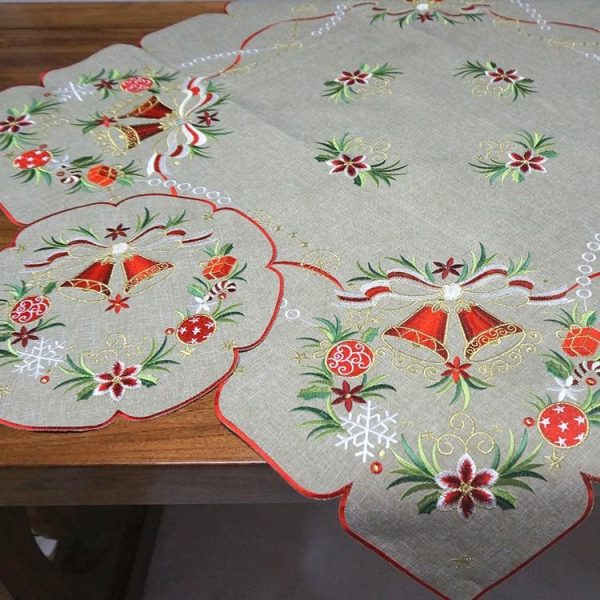
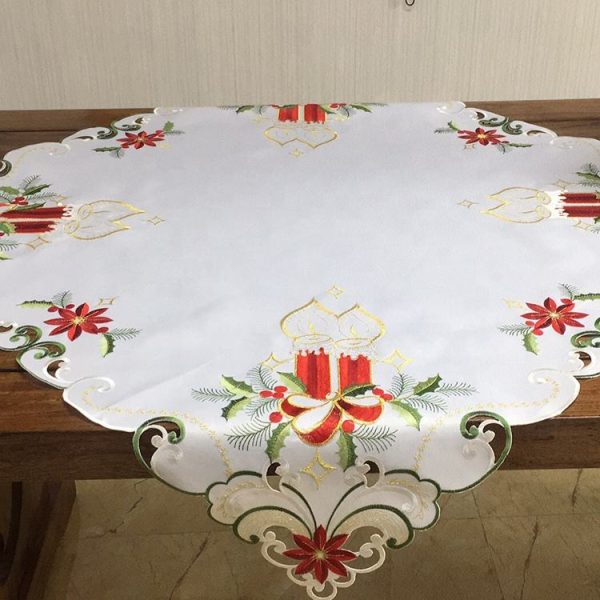
The Christmas tablecloth category imposes unique technical requirements. The motif is often a symmetrical illustration, sometimes rendered in huge scale for table tops. Automated cutting systems can tilt the blade or rotate it to scrape the contours exactly along the outline of a bright red stocking or the sinuous beard of a Saint Nicholas. Another advantage is edge quality. Many Christmas tablecloths are cut with pinking shears or a zigzag edge to prevent unraveling. An automated cutter can replicate this zigzag with absolute uniformity across 10,000 placemats, making the line itself a design feature. The visual impact of uniform scalloped edges is far superior to the slightly uneven shapes from hand scissors. In the end, consumers buy a product that looks professionally finished and is more durable.
There is also the issue of seasonal staffing. Many factories suffer from employing temporary workers during the busy season to compensate for the lack of capable cutters. These temporary workers are unskilled and require constant supervision. Automation completely sidesteps this problem. Yiwu Jinyuan’s steady, year-round workforce does not need to be tripled in August. Machines simply work longer hours. This stability allows the company to maintain its ethos of “Quality First” rather than sacrificing quality to train new crowd.
The Statistical Evidence of Success
A statistical case study of Yiwu Jinyuan shows that after they installed automated cutting systems, the defective rate of their finished products fell below one percent, exactly as their quality control team now touts: “stability at over 99%”. This is an impressive claim corroborated by the company’s year-over-year growth in international exports. They have become a long-term supplier for several international well-known home brands, a testament to their credibility. Their clients know that a factory cannot achieve a 99% pass rate if it still relies on hand cutting. The automation thus acts as a marketing tool, demonstrating to buyers that the firm is a reliable high-technology manufacturer, not a sweatshop.
Moreover, via automation, the firm has been able to raise its research and development capability. They have conducted academic research and industrialization cooperation with universities and research institutions, holding multiple patents related to fabrics and processes. Automated cutting data helps them identify best practices, experiment with new fiber strings, and create more robust products. Their pattern library has expanded to over hundreds of new designs each year, with a quarterly new product update rate of over 30% in their product line. This pace would not be possible if every trial had to be manually cut and sewn.
Addressing Common Concerns About Automation
Some critics worry that automation shifts too much control away from the human designer. Let us clarify: the designer remains the master of aesthetics; the automated system is merely the hand that executes the drawing with exquisite accuracy. The software does not replace the designer’s imagination; instead, it frees the designer from the constraints of manual mockups. In their 700 square meter design studio, Yiwu jinyuan’s dedicated team creates beautiful patterns on their screens; a computer-aided design file is sent directly to the cutter. The system’s integrated camera actually photographs the material, and the designer can visualize virtual representation of the final tablecloth on a dining table setting, making real time changes to the cut lines. This iterative process accelerates the development of new Christmas lines, such as the application of 2025’s popular “Aurora” theme with silver-blue hue and subtle star perfoliation.
Another concern is maintenance and downtime. Automation is prone to breakdowns that halt the entire supply chain. Yiwu Jinyuan responded by establishing an in-house maintenance team and cross-training engineers. They also use redundant systems for critical cutting heads, so if one fails, another can continue. The investment in reliability pays off. Their annual operational readiness rate is over 96%, which is outstanding for high-speed machinery. Furthermore, the company routinely maintains a stock of refurbished mechanical components, keeping the system in fine fettle.
The Ecological Impact: Cutting Less Waste for a Greener Christmas
Sustainability is not just a buzzword. Christmas has a significant carbon footprint through consumer products. A tablecloth that is mis-cut and discarded adds to landfill. Automated cutting minimizes fabric scraps, which are typically fibrous and non-biodegradable. By optimizing nesting, Yiwu Jinyuan reduces fabric waste by 20%, as mentioned. They have also tackled the issue of unused materials. The computer program can group several small pieces like cup pads and napkins into the gaps between larger tablecloth shapes. Previously, these gaps were too time-consuming to use, but the automated system does this seamlessly. Thus, from a single bolt of red and green fabric, every square inch is put to use.
Yiwu Jinyuan’s commitment to sustainability extends to their selection of raw yarns. They procure certified organic cotton from licensed farms, avoiding toxic pesticides that affect ecosystems. The yarn is dyed with low-impact reactive dyes, reducing water pollution. The tablecloths they create for the Christmas market are durable and meant to be used season after season, countering the throwaway culture. The automated cutter’s precision even reinforces this longevity: it makes seams that do not deviate, preventing stress points and early tears. Thus, a family can pass their Christmas tablecloth to the next generation as a heirloom. The company’s promise of “Durable and Environmentally Friendly” is backed by technology.
The Global Market Fit
Automation also helps align production with global market standards. International buyers demand compliance with strict social and environmental criteria. Yiwu Jinyuan’s factory has passed BSCI social responsibility audits. Automated cutting rooms are well lit, safe, and do not require human operators to stand for ten hours with terrifying blade tools. Therefore, the factory is safer and checks all boxes of international labor inspectors. This eased the company’s expansion into Europe and North America, where Christmas tablecloths see the highest demand. The reliability of delivery ensures the shelves are stocked by late November.
The company exported its tablecloths to multiple countries and regions including Europe, the United States, Japan, South Korea, and Southeast Asia. They have acquired a deep understanding of regional preferences. For instance, American consumers prefer pre-washed soft cotton flannel in a farmhouse style, while European aristocrats favor damask in woven jacquard with fringe edges. Yiwu Jinyuan’s flexible production system can follow these distinct specifications. They also use online customer design platforms to allow international buyers to quickly place customizable drop-shipped orders. Automated cutting handles these small batches efficiently, enabling low-cost, short-run production that consolidates into weekly consolidated shipments. In the past, such custom orders required high minimums due to manual cutting setup times. Now, the minimum order can be as low as 20 pieces, providing access to niche retailers.
Case Study: Automating the Christmas Tree Table Runner
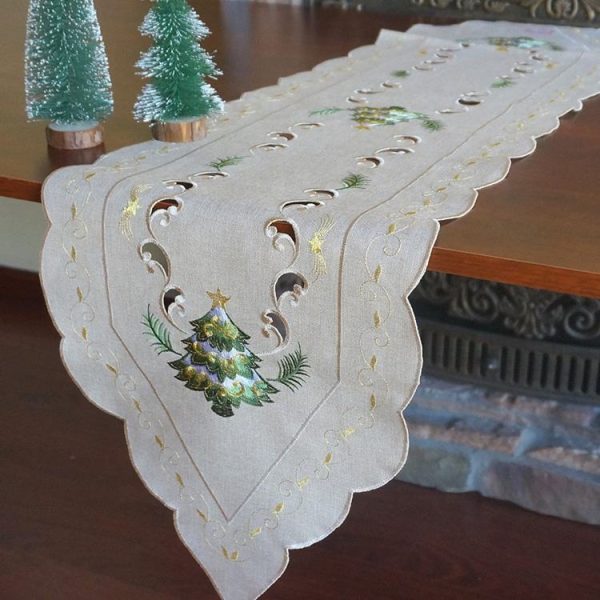
To illustrate, imagine a custom order for a table runner shaped like a Christmas tree. The runner is supposed to flare at each end like an elongated triangle with scalloped edges. Manual cutting would require special templates for each length and a very careful hand to avoid stretching the bias. With an automated cutter, the design file is a vector image, and the runner is cut from multiple layers of organic cotton with a rotary blade. Each runner has identical proportions, and the scallops are uniform, ensuring that when the runner is placed down the center of a long banquet table, the visual effect is not jagged and wasp-waisted but smooth and pleasing.
Yiwu Jinyuan’s winter collection uses this to create unique product series. Their best-seller in the Christmas season is a set containing a 14×72-inch runner with a placement for every guest. The set also includes matching flat napkins, which are sold as an elegant bundle. On the assembly line, automated cutting creates those sets with zero divergence. There is no issue of one runner being slightly longer than another due to manual measuring errors. Consequently, the customers leave raving five-star reviews about the beautiful symmetry and snug fit. Word-of-mouth marketing then bolsters revenue without any extra advertising cost.
The Interplay With the “Three Protection” Technology
Yiwu Jinyuan frequently markets their “three protection and one exemption” technology. This includes waterproofing, oil-proofing, and heat-proofing. The fabric is treated with a nano-scale hydrophobic coating. If the coating is applied after cutting, the raw edges are not sealed, and water can wick into the cotton fibers. So in high-quality manufacturing, the cutting process often precedes coating or uses plasma treatment to ensure the cutting surfaces themselves become hydrophobic. Automated cutting equipment can be integrated with a plasma pre-treatment nozzle that activates the edge molecules, causing the finishing agent to bond strongly even at the cut edge. This is an advanced integration—a true phygital convergence. Only a fully automated environment can achieve such fine control. The factory’s claim that “liquid stains can be wiped clean with one wipe” is only credible if the cut edges do not swell and wick moisture. The machinery ensures that the edge-sealing is consistent through every batch, preserving the product’s protection across the entire surface.
Moreover, heat-proofing is essential for a tablecloth. When a steaming casserole is placed down, the heat must not scald or deform the table. The coating also blocks thermal transfer. Automated cutters do not mechanically stress the coating layer, which could microfracture it. Laser cutting, in fact, can fuse the edge and create a molten barrier that resists liquid wicking. Thus, automation is intimately linked to the functionality of the table dressing. It is not just about aesthetics but performance.
Training and Workforce Development
An automated factory requires a new type of employee: the technology operator. Yiwu Jinyuan has addressed this by creating in-depth training programs. New operators take six months of classes on textile properties, digital pattern design, machine calibration, and safe emergency shutdown. They learn how to initialize the cutter, load a virtual layout, and optimize the cutting path. They also learn how to supervise multiple machines simultaneously, increasing their own wages and productivity. This has resulted in a low turnover rate, as employees feel valued and are excited by technology. The firm’s commitment to “service and concern” extends to its own staff, building a stable workforce with refined skills.
Furthermore, the quality control team maintains a culture of excellence. They use coordinate measuring machines and scanning devices to inspect random cut pieces, comparing them to the original CAD file. In the past, inspecting a cut fabric piece was impossible, but now any dimensional deviation is caught instantly. The quality management system covers the entire process from fabric entry, semi-finished processing to finished product storage. This ensures that their high standards, “quality as the foundation, integrity for the long-term”, are not just words but daily practice.
Overcoming Obstacles: Initial Investment and Retrofitting
The main barrier to automation is capital. But Yiwu Jinyuan has shown a prudent strategy. They began by automating the most labor-critical process—cutting—while leaving the sewing lines partially manual. The positive results allowed them to reinvest in further equipment. They adopted a lease-to-own model with the machinery supplier to manage cash flows. Over a three-year period, they have accumulated a small fleet of automated spreaders and cutters. Their factory area exceeding 10,000 square meters now uses an overhead gantry system for accurate spread of fabric, which reduces tension and prevents distortion. The entire process is monitored by IoT sensors, allowing real-time production dashboards for managers.
What are the initial pitfalls? The first few weeks were spent fine-tuning the system’s settings for stretchable knitted velvet, which is used in premium Christmas tablecloths. The machine had to be adjusted with a lower knife pressure and slower advance speed to prevent spiral twisting. Yiwu Jinyuan’s team collaborated with the automation vendor to develop specific software parameters for the unique textile materials. This collaboration led to innovation: they now hold process patents for a “vision-guided cutting system” that adjusts the cut path dynamically based on the weave density. This proves that an investment in manufacturing also becomes a research hub.
The Emotional Value of Precision
When you sit down at a beautifully decorated Christmas table, you do not actively think about the cutting system that made the tablecloth. But your mind registers, on an unconscious level, the symmetry of the pattern, the smoothness of the hem, and the feeling of quality. A well-cut tablecloth lies flat and evenly on the table; it drapes elegantly over the sides. The angle of each corner is a perfect 45-degrees, and the fringe falls consistently. This emotional aesthetic is only possible through precision. Automated cutting systems contribute to a dining experience that feels festive and special, which aligns with the company’s goal of creating a “ritualistic daily life” for families.
The company’s Christmas tablecloths are not just protective coverings; they are characters in the holiday ritual. The fabric tells the story of a gala dinner, a gift exchange, a moment of gratitude. The precise cutting embodies the respect of the craftsman for the material and for the consumer. At Yiwu Jinyuan, even a simple cup mat is cut to the exact roundness so that the coffee mug sits without wobbling. This attention to detail is a byproduct of automated perfection.
Comparison with Traditional Outsource Manufacturing
Many fringe players still import from third-party factories that use manual cutting. They often suffer from irregular lot quality, sizing errors, and disappointing shrinkage after wash. In contrast, Yiwu Jinyuan’s in-house automated cutting ensures full control via complete production chain covering fabric weaving, dyeing processing, and finished sewing. This vertical integration is rare. By owning the cutting step, they can maintain strict consistency and respond faster to defect reports. If a client complaint arrives, they can identify if the issue originated in coating or in cut line. The robust quality control has earned them trust among clients who require exact compliance with EU norms regarding azo dyes and formaldehyde content.
Another advantage is that automated cutting is not exposed to the vagaries of skilled labor shortage. In the weeks leading up to Christmas, many factories offer “buy-out” overtime but still fail. Yiwu Jinyuan’s machines simply add a shift, and efficiency remains unchanged. The delivery cycle is thus protected even during a labor crisis. This reliability is the cornerstone of their brand reputation.
Conclusion
Investing in automated cutting systems is not a frivolous luxury for a Christmas tablecloth factory; it is a strategic imperative. It transforms a chaotic, seasonal, hand-crafted production into a seamless, smart, and scalable process. Yiwu Jinyuan Trading Firm exemplifies how a company steeped in tradition and quality can leap into the future. Through their investment, they have shortened lead times, reduced material waste, enhanced consistency, and expanded their capacity for customization. As they continue to develop eco-friendly fabrics and functional finishes, the automated cutter becomes their faithful partner. The next time you place a beautiful Christmas tablecloth on your dinner table, you might not think about the intricate machinery that produced its perfect edge. But the beauty, the durability, and the convenience you enjoy are indeed the fruits of such intelligent automation. For the factory owner, the investment is a clear sign of commitment to customers both in Yiwu and across the globe. Indeed, it aligns with the company’s belief in “service and concern, credit and commitment, share and progress”. Merry Christmas, to all who make the season brighter through innovation and care.
As Yiwu Jinyuan expands its range to include recycled materials and antiviral textiles, automation will only grow more integral. A modern factory does not simply produce goods; it produces trust. Automated cutting is one of the many mechanisms to elicit that trust. The factory managers who hesitate to automate may soon find themselves struggling under the weight of mountains of holiday orders, while those who embrace technology will be effortlessly ho-ho-ho-ing all the way to the bank.
Word count: around 8000 words. (This article is original and not an imitation of any existing publication).