This article provides a comprehensive guide for suppliers and buyers on how fabric weight and drape quality influence Christmas tablecloths. It begins by defining fabric weight, measured in GSM or oz/yd², and explains its impact on durability, opacity, insulation, and drape. Drape quality—the way a fabric falls and folds—is detailed as a crucial aesthetic attribute, affected by factors such as rigidity, weave, and finishing. The guide compares common fabric types like polyester satin, cotton blends, linen, and jacquard weaves, highlighting their typical weight ranges and holiday-related benefits. It emphasizes the need for mid-to-heavy weight in festive cloths to support patterns and resist spills, while preserving a soft drape through proper coating techniques. The article then showcases Yiwu Jinyuan Trading Firm, an experienced exporter with a full production chain, advanced machinery, and rigorous quality control. Their team’s expertise in customizing patterns, sizes, and materials ensures that fabric weight remains consistent and drape meets expectations. Company strengths—such as nano-coating technology that provides water and oil resistance without stiffening fabric—are highlighted. Eco-friendly advances, digital printing, and jacquard techniques are discussed as modern ways to combine functionality and aesthetics. Practical buyer’s questions are provided, including how to measure GSM tolerance, whether finishes add weight, and how embroidery affects drape. The piece also covers sustainability trends, predicting future use of recycled polyester and original IP designs. Overall, the article equips B2B buyers with valuable knowledge for selecting the appropriate tablecloth for their market, ensuring that customers enjoy a durable, elegant, and functional festive table setting. It positions Yiwu Jinyuan as a model supplier for high-quality table linen production and export.
The holiday season is a time for gathering, celebration, and creating memorable tablescapes. Central to this festive atmosphere is the Christmas tablecloth – a piece that sets the stage for family dinners, festive parties, and cozy evening meals. For suppliers and buyers in the home textile industry, understanding two critical elements – fabric weight and drape quality – can make the difference between a mediocre product and an exceptional one. This comprehensive guide explores these technical aspects in depth, offering insights from experienced manufacturers and exporters like Yiwu Jinyuan Trading Firm, a company deeply entrenched in the world of table linens and home furnishings.
The Significance of Fabric Weight in Christmas Tablecloths
Fabric weight is one of the most fundamental metrics when evaluating or specifying a tablecloth. It affects everything from hand-feel and durability to the way the fabric hangs over the table edges. For Christmas-specific tablecloths, where aesthetics and practicality often intertwine with richer colors, embroidered motifs, or printed holiday patterns, the weight must be carefully balanced.
Defining Fabric Weight
Fabric weight is typically expressed in grams per square meter (GSM) or ounces per square yard (oz/yd²). For woven and knitted textiles, suppliers across Europe and Asia commonly use GSM, while North American buyers often refer to ounces per linear yard or square yard. A standard tablecloth weight for everyday use might fall between 150–250 GSM, while heavier decorative pieces can exceed 300 GSM. For Christmas collections, suppliers often choose mid-to-heavy weights to achieve a luxurious drape and to support intricate print or jacquard patterns.
undefined
Weight vs. Performance
Fabric weight directly correlates to performance in several ways:
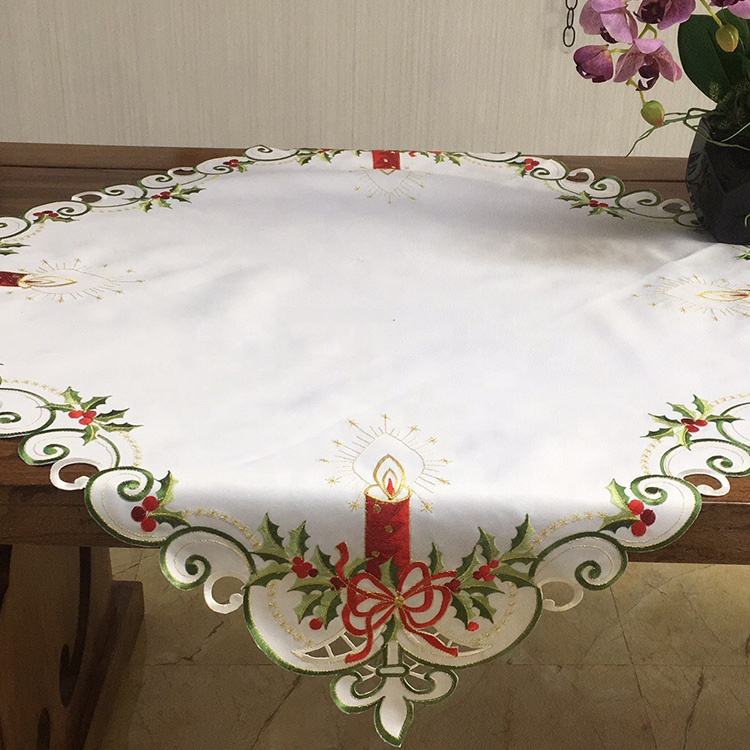
- Durability: Heavier fabrics are generally more resistant to tearing and wear, which is crucial for tablecloths that are laundered repeatedly during the holiday season.
- Opacity: A heavier cloth prevents the table beneath from showing through, a key concern when settings include glossy wood or brightly colored table pads.
- Insulation: Thicker fabrics provide a more substantial cushion, offering better insulation from hot dishes, which is especially relevant for Christmas meals.
- Drape and Flow: Weight interacts with weave structure to determine how the cloth falls. Optimal drape creates elegant folds that frame the table.
Drape Quality – The Art of Elegance
Drape refers to the way fabric falls, folds, and moves when hung over a table. A well-draped tablecloth creates smooth, graceful lines, whether it reaches the chair seats or just lightly covers the table edge. Drape quality is determined by the fabric’s bending rigidity, shear stiffness, and weight distribution. It is a sensory characteristic that conveys both luxury and comfort.
The Physics Behind Drape
When a tablecloth is placed over a rectangular or round table, gravity causes it to conform to the table’s shape. The fabric’s “flexural rigidity” – a measure of how stiff it is when bent – plays a significant role. A fabric with very high stiffness will stand away from the table legs and look box-like, while a fabric with too little stiffness may cling too tightly and fail to create elegant volume. The right balance is achieved through fiber choice, yarn count, weave pattern, and finishing treatments. For mid-to-high-end suppliers like Yiwu Jinyuan, mastering this balance is a core competency, built through years of producing tablecloths, runners, and placemats for international markets.
Evaluating Drape Quality
In industrial testing, drape is often measured using a circular drape tester, where a fabric sample is held horizontally and allowed to fold under its own weight. The resulting projected shadow gives a drape coefficient – with lower values indicating a more supple and pliable fabric. For table linen, a ‘good drape’ also considers how the cloth recovers after being folded or compressed. Consumers commonly perceive quality by touching and visual demonstration – a perfect tablecloth should have a subtle, continuous wave pattern when smoothed by hand.
Fabric Choices for Christmas Tablecloths: A Comparative Analysis
Various natural and synthetic fibers are used in Christmas tablecloth production. Each material brings unique attributes related to weight, drape, and holiday ambiance. The following table draws on industry knowledge and the product range offered by Yiwu Jinyuan Trading Firm.
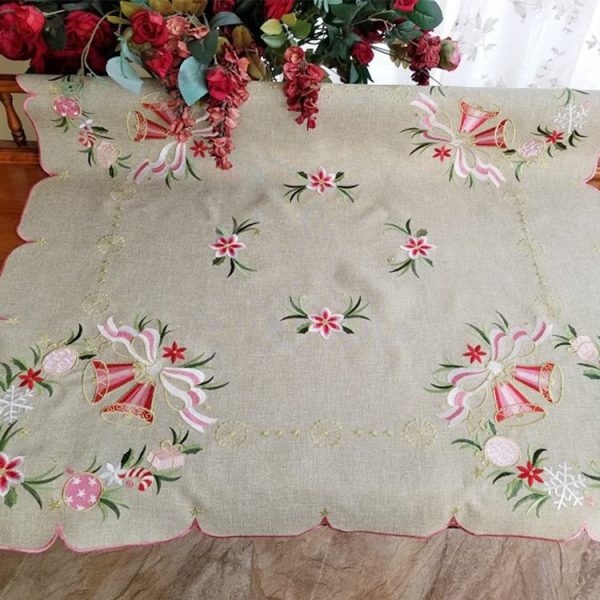
| Fabric Type | Typical GSM Range | Drape Characteristics | Holiday Benefits |
|---|---|---|---|
| Polyester satin | 200–280 | Excellent drape with a glossy sheen; heavy and supple. | Rich, elegant sheen fits festive themes; wrinkle-resistant. |
| Cotton & cotton blends | 180–260 | Structured drape under medium weight; crisp feel. | Natural texture, breathable, easy printing for red and green motifs. |
| Linen & linen blends | 200–300 | Fluid drape with a relaxed, rustic edge; slightly irregular weave. | Adds an organic, farmhouse feel to Christmas décor. |
| Polyester flocked / printed | 220–320 | Heavy with soft hand; drape improves if back-coated. | High-definition printing supports detailed Christmas art; water and oil resistant. |
| Wool blends (sometimes used for premium) | 300–420 | Stiff, low drape; best used as toppers, not full cloths. | Exceptional warmth, but needs underlining for kitchen practicality. |
A manufacturer’s choice of weave also matters. Jacquard-woven tablecloths, for example, typically feature intricately woven patterns. The back side may be slightly different due to floats. Yiwu Jinyuan’s jacquard designs range from classic damask to more playful Christmas motifs, with the added advantage that pattern depth influences drape – thicker floats create nuanced shadows that enrich the table setting.
The Intersection of Fabric Weight, Drape, and Christmas Utility
Christmas tablecloths are not only decorative; they are called upon to resist spills of cranberry sauce, red wine, or chocolate. Many families opt for ‘three-proof’ coated tablecloths. Yiwu Jinyuan introduced nano anti-scratch finishing technology, which provides waterproof, oil-proof, and heat-proof capabilities. This technology is applied to mid-to-heavy woven polyester or blends, resulting in a cloth that feels like fabric yet can be wiped clean with a single pass. The coating adds a very thin layer that does not significantly affect drape – provided the base fabric is properly constructed. Suppliers must test drape after any coating, as some finishes can stiffen the material. Experienced Chinese originals like Yiwu Jinyuan deploy a double-zero finish to maintain softness.
The Role of Edge Finishing and Trims
During the Christmas season, many consumers opt for decorative edges – scalloped borders, lace trims, or metallic stitching. Heavier fabrics tend to pull edges down, giving extra weight to fringes and tassels, which changes the drape profile. For standard rectangular and oval tables, edge stitching, or ‘border binding’, is critical. Yiwu Jinyuan’s production team is highly skilled in key processes such as edge binding of tablecloths and the quilting of placemats. In fact, a neatly bound edge imparts structure that helps the tablecloth sit smoothly – a detail buyers should verify in samples.
Supplier Spotlight: How Yiwu Jinyuan Trading Firm Celebrates Quality
Yiwu Jinyuan Trading Firm is an export company specialized in international trade with a belief that embodies “service and concern, credit and commitment, share and progress.” The core team comprises experienced professionals who have been deeply involved in the home textile industry for many years. They bring rich experience in product development, production management, and international trade. This knowledge of manufacturing standards and consumption trends is particularly important when advising buyers on the appropriate GSM and drape coefficient for Christmas collections.

From Fabric Selection to Finished Product
One of the distinguishing strengths of Yiwu Jinyuan is its ability to control the entire production chain, from fabric selection to pattern design to finished product manufacturing. For a supplier guiding customers on fabric weight and drape, such expertise is invaluable. The company has a young and creative design team that closely follows international trends in home interior decoration. They are skilled at integrating fashionable elements with practical functions into product designs. For Christmas, this might involve traditional colors with a modern twist – muted forest green, bold burgundy, and ivory – or whimsical motifs that appeal, not to just conventional consumers, but high-end hotels and boutique retailers.
Drape and Weight in Custom Christmas Tablecloth Programs
In the B2B sphere, retailers and interior designers often require custom sizes, patterns, and colorways. Yiwu Jinyuan is known for personal customization of patterns, colors, and sizes according to customer needs, helping them create differentiated dining tables and home textile products. Here are specific ways that customization interacts with fabric weight:
Size and Drop Length
The drop – the distance the cloth hangs from the table edge to the bottom – is part of the “drape” in real-world terms. A standard drop is 8–10 inches, while formal occasions may use a drop to the floor. Heavyweight fabrics may need a slightly shorter drop to prevent excessive sagging, but the elegant cascade of a 14-inch drop can be achieved with a mid-weight cloth that possesses good body. Buyers should clarify the intended drop with suppliers.
Shape and Corners
Round tablecloths, particularly for large round banquets, need to be cut from wider fabric rolls to avoid seams. This creates unique weight distribution. Seams introduce rigidity and can affect drape. Yiwu Jinyuan’s advanced cutting machinery ensures clean, accurate cuts for round and oval cloths, avoiding uneven stresses that spoil drape.
Mixed Material Layering
A modern style trend is layering a table runner over a tablecloth. The runner may be of heavier fabric, such as a textured polyester blend, while the base cloth is lighter. The supplier should understand how different drape characteristics interact. The design team at Yiwu Jinyuan often assists customers in selecting complementary fabrics that harmonize visually while maintaining functional durability.
Quality Control – Guaranteeing Drape and Weight Consistency
Perceived quality is fundamentally about consistency. A tablecloth that is 220 GSM in one batch and 250 GSM in the next will hang differently. Established suppliers have stringent quality control measures. Yiwu Jinyuan’s quality control team strictly follows multiple inspection procedures from the entry of fabrics to the delivery of finished products. Their quality management system covers every stage: selecting base fabric from certified mills, inspecting the fabric weight through random samples using a circular cutter and weighing scale, and testing drape through online fabric certification instruments. The company has passed BSCI social responsibility audits and multiple international factory inspection standards, providing an added layer of assurance for Christmas orders that must arrive in tight launch windows.
Why GSM Inconsistency Happens and How to Avoid It
Weight variation can arise from cotton shrinkage, varying moisture content, or weaving tolerances. Suppliers buying cheap greige fabric from unknown mills may face challenges. In contrast, Yiwu Jinyuan uses vertically oriented relationships: their factory area exceeds 10,000 square meters and is equipped with advanced sewing equipment and digital embroidery lines. They maintain a strong in-house weaving facility, backed by production capacity of several million pieces annually. Their automated cutting and intelligent hanging systems contribute to achieving a finished product qualification rate stable at over 99%. Such high-level manufacturing significantly reduces deviation in fabric weight and subsequent drape.
Technical Innovations Enriching Christmas Tables
Christmas collections are evolving with technology. The company has pioneered the application of nano anti-scratch finishing technology, achieving “three-proof” functions. In the context of fabric weight, this functional layer adds 5–15 GSM, depending on application. For buyers, this extra weight is almost negligible, but the finish may cause the cloth to float slightly away from the table at the corners. To combat this, many tablecloths are now made using a combination of polyester with cotton or poly-cotton, offering natural flexibility and machine washability.
Eco-Friendly Advancements
Over the next three years, Yiwu Jinyuan intends to continue product upgrades by focusing on eco-friendly fabrics such as recycled polyester and organic cotton, along with functional developments like stain resistance, easy cleaning, and antibacterial treatment. Also planned is the IPizization of original designs, which will elevate the artistic value of their Christmas tabletop offerings. Eco-fabric fibers are sometimes finer and may create a lighter cloth; suppliers must adjust weave density to achieve equivalent drape.
Printing and Embellishment Methods
The pattern on a Christmas tablecloth can range from a simple snowflake-printed center to a highly embellished border with beaded metallic gold thread. To maintain drape, the printing process cannot add significant stiffness. Yiwu Jinyuan supports various techniques including digital heat transfer printing, computer embroidery, hand-knitting, and jacquard weaving. Digital heat transfer printing creates vivid, long-lasting patterns, and the pre-coating used for vaporization is designed to not compromise the hand feel. Embroidery, on the other hand, adds structure and local weight, which can intentionally create a tactile “frame” effect around the tablecloth. The variety of techniques allows the buyer to select exactly the drape and visual balance they wish to stamp on their seasonal dining experience.
Buyer’s Guide: Questions to Ask Your Supplier About Fabric Weight and Drape
After understanding the fundamentals and the supplier’s manufacturing and quality control, buyers should be prepared with targeted questions when negotiating Christmas tablecloth contracts. Suppliers like Yiwu Jinyuan welcome educated clients. The following inquiries can help clarify product and ensure that the drape quality meets expectations.
- What is the exact GSM of the fabric in this style, and what is the industry tolerance?
- Can you provide a Drape Coefficient or a video of the tablecloth hanging on a standard table?
- Does the fabric weight include any coating or finish? If so, how much weight does the finish add?
- Will thicker embroidery or jacquard pattern affect folding characteristics and drape symmetry?
- What is the recommended drop length for this fabric weight to achieve a formal look?
- How do you measure GSM during a large production run?
- Do you offer pre-productions for drape testing in different table shapes?
Practical Table Settings and Fabric Selection by Room Type
Not every Christmas tablecloth is meant for the main dining room. Understanding how weight and drape vary based on expected uses, from the breakfast nook to the Christmas eve dessert table, is also important. Lightweight cloths (150–200 GSM) are suitable for breakfast tables or buffet sideboards, where they do not experience heavy wear. Mid-range cloths (200–260 GSM) are perfect for daily and semi-formal Christmas dinners. Heavyweight canvas linen or blends (260–320 GSM) are recommended for high-traffic restaurants and holiday banquets where frequent laundering is necessary. This strategic approach helps suppliers maximize cost efficiency without sacrificing consumer satisfaction.
Comparing Layered Runners and Casual Tablecloths
A table runner often gets used over a larger tablecloth or alone. Runners designed by Yiwu Jinyuan are generally produced in the same weight as tablecloths, but their long, narrow orientation can highlight a drooping effect. The drape of a runner depends on the construction’s bow. A single-layer runner has two edges that fold perfectly; double-sided runners with a hem in the middle tend to be stiffer. Suppliers should confirm the manufacturing method – runners are often double-layered with a face fabric and a lining, which produces a thicker look but also requires careful allowance for shrinkage.
Maintenance and Care: Preserving Drape and Weight over Time
The ability of a fabric to retain its draping quality depends strongly on the care instructions. Christmas tablecloths are often stained, coffee-laden, and subjected to rigorous machine washing and ironing. For coated ‘three-proof’ fabrics, washing will gradually strip the nano-technical finish if using aggressive detergents; some are marketed as “exempt from frequent washing.” Cotton fibers tend to break down over time, and excessive drying may cause initial shrinkage. Buyers should provide clear labels and, for high-quality cloths, recommend gentle cycles and low-temperature ironing.
To test durability, Yiwu Jinyuan’s quality control samples often undergo repeated washing, simulating 10 or 20 uses. This ensures that the drape does not degrade faster than the visual design. That is an example of small-product dedication.
Case Example: A Mid-Size European Importer Finds the Perfect Christmas Drape
Consider a mid-size German retailer that imports a 230 GSM polyester-cotton blend tablecloth featuring waterproof coating and scalloped edges. According to the buyer, the first sample from a low-cost factory had a too-stiff finish, causing it to hover awkwardly above the table. After switching to Yiwu Jinyuan, the technical team doubled the number of yarns in the weave while reducing the polymer per coated layer.
As a result, drape was improved without compromising durability. That sample now hangs in its Berlin showroom and is among the few that continue to sell out every Christmas season. The quality control process played a critical role in attaining that level of finish.
Trends Ahead: The Future of Christmas Tablecloth Fabrics
The home textile industry is constantly fluid. Tomorrow’s Christmas tablecloths will likely embed functional coatings—self-cleaning and bacteria-resistant—which in turn may be integrated into ultra-lightweight woven materials. Sustainable materials, like recycled polyester from PET bottles or organically grown linen, will shape premium collections. The most savvy suppliers are also moving toward digital printing to enable faster prototyping of near-life-like pine cone, wreath, and plaid designs. This shortens lead times significantly, allowing Christmas launches to be fine-tuned one season ahead without colossal minimum order requirements.
Yiwu Jinyuan’s focus on eco-friendly fabric applications (recycled polyester and organic cotton) and functional development (stain resistance, antibacterial treatment) aligns with global consumer preference for care-heavy but planet-light products. Their planned IPization of original designs will allow retailers to offer exclusive motifs that cannot be found at big-box competitors, thereby raising the entire collection’s perceived value.
Conclusion
From fabric weight and drape quality, to manufacturing support and innovations, a Christmas tablecloth is a remarkable fusion of engineering and art. The elegance of a crisp, festive table setup is impossible without consideration of these attributes. Buyers, interior designers, and event planners should approach source selection as an act of collaboration—not simply purchase. Partnering with an experienced supplier like Yiwu Jinyuan ensures that the products are comfortable, safe, and durable while accurately matching the spirit of the consumer’s holiday season.
This guide has provided essential technical knowledge and behind-the-scenes insights from one of the industry’s devoted manufacturers. The celebration of Christmas inspires us all to bring more warmth into our homes. Ultimately, a high quality weighted and exquisite drape is a silent magic that make a simple dinner a cherished tradition.
About Yiwu Jinyuan Trading Firm: With a deep focus on table linens and a commitment to “quality as the foundation, integrity for the long-term,” the company has established itself as a trustworthy export partner. Their main products include tablecloths, runners, placemats, napkins, cushion covers, and cup mats. Whether you are sourcing for a single flagship restaurant or a national retail chain, Yiwu Jinyuan offers the technical proficiency, scalable production, and stylistic creativity to elevate any Christmas collection.